This is a guided meditation written by Helen Forslund Slomovits (1950-2012) based on an experience she had in January of 2011, at the Loma de Ensueños — Hillside of Dreams, a deforested area in Ecuador which she was helping to restore. It is also the site of a retreat center she helped found with the Ecuadorian Yachak, teacher and healer, Don Alverto Taxo.
The drawing, also by Helen, is based on a photograph taken of her hand, holding the hummingbird.
I want to tell you the story of an experience I had recently in Ecuador, and I invite you to experience it with me. You might want to take a deep breath to come fully present.
I don't hear the thwack against the window. I'm in another room having a cherished quiet moment alone. But my son's wail brings me quickly. "A bird hit our front window hard! How terrible; it's probably dead already." Geared for tragedy and loss, he is, and near tears.
Something in me feels ready and able, knowing what to do. I go outside and find the baby hummingbird, stunned on the cement porch near the front window. I look carefully and see it is breathing. Slowly approaching, I somehow know it will let me pick it up, so I do with great care. I hold it between my two hands, giving it life energy to use as it will—either to leave the body quickly and easily, or to stay. I don't presume either way. I truly only want to serve its desire and need.
Shock allows for a swift, painless exit from the body. Birds are good at that—so alive when here, so easy to let go when their time comes. But this bird's breathing continues, so very rapid—3 times a second or more, letting me know that for this moment anyway, it is still here, alive.
As more minutes pass and I warm it with my hands and feed it energy, the growing likelihood of it choosing to live dawns in me. I peek between my hands. Fifteen minutes have passed. One small black eye, then the other opens for a little, shuts and then opens again.
I watch for my healer friend to return. I can see him in the distance, talking to a neighbor, too far away to hail. He just recently nursed a stunned bird that he found on the hillside, back to life and freedom again. Yet this bird has come to my care, and she's staying minute by minute longer.
Finally I see him walking up towards the house. I call to him and get up carefully, disturbing the wee bird in the process. I feel a fluttering of wings between my hands. But the wings are all askew. Will they ever be able to fly again? A hummingbird is such a delicate creature. I wonder how the long, curved beak could have withstood the force of the impact with the glass, unharmed, yet I see no signs of injury or blood.
My friend arrives and I show him the tiny bird. He immediately smoothes its wings into their proper place and I'm relieved to see them, looking normal again. In his wisdom he knows that it is important to offer the elements to the little bird—earth, water, air, fire—as a way of calling her spirit back into her body.
He quickly finds honey, water, a spoon and a little cage which he's used before to shelter wounded birds. He makes up some water with a bit of sweet and tastes it to be sure it's not too sweet, finds a spoon and gently taps at the beak, pouring out a few sweet drops. A second and third time he does this, and then we see the bird's mouth move and drink.
My healer friend fans her, blows strongly on her. "She needs air to help her breathe, to remind her to fly." He happily notes her tenacity in keeping her balance when he blows extra hard. "She's a strong one!" He fans her again and again, knowing the power of air, the affinity of bird and air, the necessity for her to reconnect with the power of air, to call to the spark of her spirit and fan it back into the will to live again.
We open the bird cage door and I carefully put my hand, with bird, inside. Her black eyes watch, but she still seems somewhat stunned. Her mouth takes in more sips of nectar. It is time to withdraw my hand. I sense that she needs to be left alone, that she's received from me whatever was needed. In the process of taking my hand out, she startles and flies to the side of the cage, tiny claws grabbing onto the metal bars, and beak and tiny head trying to push through the bars to escape. Her short flight leaves us hopeful and happy. We move away and leave her alone, to continue regaining her strength.
After about 45 minutes my friend tries to feed her again, but now she responds like the wild creature she is, flying desperately away from him, wings whirring, bumping into the sides of the cage, trying to escape. "She seems strong, unharmed and clearly wants her freedom." So we take the cage outside. He manages to close his hand around her, remove it from the cage and release her. She flies, like a shot, straight to a flowering bush about 3 feet away. At first it looks like she's made a bee-line to the nectar of a flower, but then my son sees her hanging from a stem, beak-down, looking stunned. "I don't think she's ok! We should never have let her go!"
But I feel hopeful, and I also know that our part in her life is now over. She continues to hang upside-down, motionless, but holding on tightly. I decide it's time to continue on with my own activities, and I say good-bye and wish her the very best. About fifteen minutes later, I come back out to see her. The branch is empty—she's flown free!
Two mornings later as I'm waking—suddenly the little hummingbird's image and spirit is with me. She's well and I feel she's come to let me know and to say thank you. In the physical we never see her again, but I have the happy sense that she is living out her nectar-sipping life on our hillside.
I've often wondered since then why I was given this gift—the presence of such a delicate winged spirit—and why I was given the chance to offer healing energy. It was a precious gift to my heart to open and give love, to surrender to life's will, and then to be delighted at her recovery.
So now, I invite you to spend a moment with your own heart.....What tiny heart-bird lies there stunned from crashing into one of life's pains? What delicate, sweet part of you needs the love that only you can give. Take her in your hands. Give her your love; invite her back to life and to fly free again!
We were together for more than 41 years, essentially our entire adult lives. She was my beloved, my wife, the mother of our son, one of my main musical partners, my steadfast companion on the spiritual path, my teacher in so many ways, and the one who always, always, always encouraged and supported me in following my dreams.
And she was so much more. A few days after her death, our son, Daniel, and I were trying to deal with one of the myriad details around the house that she had always taken care of. At one point he turned to me and said, "Dad, you brought in the money. Mom did everything else." Which is a slight exaggeration, but only a slight one! I'd be incredibly grateful to her if all she had done in her life was to take care of our household. But she did, and was, so much more!
Here is a partial list of her outer accomplishments:
She graduated Phi Beta Kappa from the University of Rochester (which is where we met) with a BA in Asian Art History. After we moved to Ann Arbor in 1973, she worked at a picture-framing store and later owned and operated one. She learned pottery in her mid-20's and for a number of years had a booth at the Ann Arbor Art Fair. She facilitated Artist Way workshops, encouraging many, many people to find ways to express their creativity. After discovering that our son had Asperger's Syndrome and other special needs, she became interested in various energy healing modalities, and mastered several as a way to help him.
In 2000, she met a highly regarded Ecuadorian teacher and healer, Don Alverto Taxo, and over the next few years compiled, edited and published several of his books. She arranged and facilitated a number of his appearances in Ann Arbor, as well as in other parts of Michigan, New York and California. In the process, she learned Spanish (which she had not known at all) well enough to be able to translate his talks. Between 2001-2012 she traveled extensively in Ecuador, studying with Don Alverto. Through him she met several indigenous Ecuadorian musicians for whom she arranged concerts in Ann Arbor and other parts of Michigan and the US. Along with me, she performed and recorded with them, both original and traditional folk music that was a fusion of North and South American influences.
Perhaps her greatest accomplishments came in music. She'd studied classical flute since her childhood, attended the High School of Music and Art in New York City, and took flute lessons at the Eastman School of Music while at the University of Rochester. When we met, she had never played folk music or played by ear — but she learned, and along the way, taught me to be able to notate music. In her late 40's she decided to fulfill a lifelong desire to play harp — and became a wonderful Celtic Harp player. She also learned to play the Native American flute, as well as some of the folk flutes of the Andes.
But it was on the classical silver flute that she did the most. She played flute on almost every one of the more than a dozen Gemini recordings my brother and I released starting in the early 1980's. In the 80's she also recorded flute parts on each of eleven albums of folk dance tunes Gemini recorded for the High Scope Educational Research Foundation. From the 1990's until just a month before her death, she played flute on more than a dozen recordings, ranging from my solo CDs of the poetry of Rumi and Hafiz, to folk music with Andean musicians, to her own solo recording, "Darkening of the Moon," which featured not only her flute playing, but also her singing, composing and song-writing.
So, that's an abbreviated list of her outer accomplishments. But she was so much more than the sum of those. Since her death, I've gotten hundreds of cards, e-mails and phone calls from people all over the country whose lives she had touched. Many of them mention some of these external accomplishments, as well as other ones too numerous to mention, specific to a particular time, place, event or person. But what people remember most about her is her genuine kindness and caring about people, her determination to live a life of meaning, and her drive to inspire and encourage others to do the same. And though I'll miss terribly so many things now that she's gone, what I'll miss most is this kindness and caring which I experienced on a daily basis, and which was the support of my life all these years.
And, as you can see from the photo, she was beautiful — and from her smile and the light in her eyes I know you can tell her spirit was as lovely as her form. That spirit expressed itself in so many ways, but certainly one of the most important to her was her connection to nature. She took such delight in, and felt so much gratitude for the beauty, inspiration, guidance and healing power to be found in nature. She also felt a great affinity to, and compassion for, trees and animals — and wanted to learn as much as she could about ways human beings could best relate to them.
One example, almost at random, out of so many I could tell: A few years ago I unknowingly bumped into a yellow jacket nest in a stump in our yard, was stung by several, and chased by a number of others as I ran into the house. Helen calmly took care of me with a rescue remedy and a homeopathic, settled down our son who was quite upset because he'd been stung by a swarm of bees earlier that summer, and then went to attend to the 5-6 yellow jackets circling around in the kitchen. She started talking to them very gently, using her open hands to guide them lightly towards the open window. It only took her a few minutes to get them all out, and there was no hint that any of them might sting her.
She was my teacher in so many ways — from relatively small things she taught me on a daily basis, to basic attitudes that have come to permeate my entire life. Let me give you two tiny examples of things she taught me:
We always enjoyed going for walks together. Many years ago, one day when we went for a walk after it had rained, she stopped after we had gone just a few yards, and picked up an earthworm wriggling on the sidewalk and set it back on the grass. Since there were a lot of worms in that condition, we didn't get very far on the walk that day! She'd also pick up earthworms on hot summer days to keep them from drying out on the sidewalk. Later, I began to see how that was an image for how she was with me, and with many other people, helping us when inspiration ran dry, and we were wriggling on a hard, hot surface.
The second example will also give you a taste of the sense of humor with which she taught me. I'd been brought up in a household where the strongest curse word was the Hungarian equivalent of "Darn." And though I learned English curse words quickly enough when we moved to America when my brother and I were eleven years old, I basically never used them — till I went to college. It was the late 1960's and I fully and enthusiastically embraced the rebellious language of the hippies, and used the f word and other such quite liberally. When Helen was about five months pregnant with Daniel, I let loose with that language about some mild annoyance. Helen looked at me serenely and said very sweetly, "Well, you could stop using that language now, or you could wait until you hear it coming out of our child's mouth."
But she didn't just teach me relatively small things like that. She taught me most everything I know about notating music, and introduced me to a great deal of music she loved that I might never have explored — especially classical Indian music, and the folk music of the Celtic and Andean cultures. She introduced me to an ancient tradition of connection to nature, which I'd never had, through Ecuadorian teachers and musicians. She also brought me to the spiritual path, Siddha Yoga, that she and I walked together since our late 20's — we meditated together almost on a daily basis.
She was the same way with Daniel, never missing an opportunity to teach him something — especially something to do with nature and the wonder of the universe. One night a few years ago, when Daniel was almost 17, she heard that there would be a meteor shower around midnight. Knowing that Daniel would be up at that time, (and that I wouldn't since I needed to leave early in the morning for a gig) she set an alarm clock, muffled under her pillow, got up around 11:30, took Daniel outside, and they stood looking up at the sky. Not being able to see much because of the streetlight, she went over to a neighbor's driveway, and lay down on the concrete to look up. Daniel followed suit, and the two of them lay on their backs looking up at the stars for a long time.
She was also pretty unstoppable when she made up her mind to do something. A tiny example: We live at the top of a short, steep hill. One winter day many years ago, when Helen stepped out the front door to walk to her picture framing job downtown, she saw that the street and sidewalk were covered with ice. She came back in, grabbed a large, flattened cardboard box from our recycling bin, and went off with a grin on her face. "I'm going sledding" she said, and slid all the way down the hill, and then continued on her way.
She put that ability to persevere to especially good use in advocating for Daniel when he started school. She was absolutely tireless in researching what procedures and accommodations were in place to help him with his special needs. In the days after her death, as we started to hear from some of the teachers and administrators she had interacted with over the years, almost every one of them said something like, "She was amazingly dedicated to Daniel — but was always totally respectful in the way she asked for things for him." The fact that Daniel has had a very successful academic career (semi-finalist in the national Presidential Scholar program, with straight A's through High School and his first few college courses) is totally a testament to Helen's support of him. And she definitely instilled that quality of perseverance in him by her example.
Like everyone who has lost a spouse or someone they loved deeply for a long time, I've had my moments when I've wondered if I can go on. Though it's a well-worn cliché, during these dark moments, Daniel and I have asked each other and ourselves, "What would Helen want us to do?" There is no doubt about her answer. She said it to me as one of her last words in the final hour of her life. I was sitting on the side of her hospital bed, starting to cry, as I realized she was dying. She was fully lucid and calm. We talked completely openly with each other, both of us realizing this would be the last time we would see each other. I told her how much I loved her and how grateful I was for all she had done for me. I also asked for her forgiveness for anything I had done to hurt her. And she said all of these back to me. And then, seeing how hard I was crying, she said, still totally tranquilly, but with all the conviction she had lived by her entire life, "Laz, don't give up."
Even in her last moments she was teaching me by her example — she was utterly fearless. Not that she was acting brave or strong — just that there was no hint in her expression, her voice, or in anything she said, that she was anything but totally trustful and at peace.
• • • • •
The evening of the day Helen passed away, I told Daniel we needed to go water our Project Grow garden because it had been very dry and we hadn't gone for a number of days. He was reluctant to go and said, "But the garden will remind us of Mom." (She, of course, had been the main motivating force behind us having that garden, and learning how to take care of it.) I replied, "I'm sorry, Daniel, but everything will remind us of Mom." And, of course, there is great sadness in being reminded of her absence everywhere we turn — and, there is also the great blessing of being reminded by everything of her having been in our lives. I am very, very sad that there are no more years — or even an hour — to add to those 41 years. But I am so grateful for those 41 years, and all the sweetness in the memories of them.
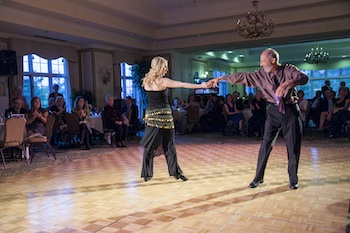
When I was invited to be one of the "stars" in a Dancing with the Ann Arbor Stars benefit, I felt like someone invited to sing a duet with Renee Fleming at the Met after only ever singing in public in karaoke bars. If I'd been asked to jump from an airplane with a parachute of questionable quality I'd likely have been more willing to agree. The idea terrified me.
So my immediate and emphatic response was "No!" But this Dancing with the Stars was a benefit for two organizations very dear to me; the Rudolf Steiner School of Ann Arbor, where my daughter, Emily has gone since kindergarten, and Wild Swan Theatre, longtime friends, and simply the best children's theater around. So I finally said "yes." It was the best thing I've done in a long time.
My three minutes and eight seconds of fame in the Dancing with the Ann Arbor Stars was such a delight that ever since that night I have been contemplating a career change. No, not hardly, but I did have a blast. And even more than the performance itself, I enjoyed the preparation leading up to it. After all, practicing for a dance performance is not unlike rehearsing for a concert; endless repetition of an enjoyable activity—always with the goal of an unattainable perfection worth striving for.
My coach was Jackie Steinbacher, a superb dancer and, if possible, an even better choreographer and teacher. We chose Tish Hinojosa's beautiful song, Esperate, and Jackie created a routine that combined moves and steps from cha cha, paso doble, samba, and even a hint of swing. She tailored our dance perfectly to the different moods and rhythmic subtleties in the music and the lyrics, creating a challenging and very satisfying piece that somehow also managed to minimize my many, many limitations as a dancer.
I was as nervous—and then some—for our performance than for any musical appearance I can ever recall. Before we danced, my mouth felt like I'd been eating dry peanut butter mixed with sand, and my hands were so cold it seemed as though I'd been soaking them in a bucket of ice water for a week. I felt sorry for Jackie in her sleeveless top. I hoped she wouldn't cringe when I touched her shoulder.
And then the music started; music, which has been my friend, my go-to safe haven, for most of my life. This would be the secure boat I would sail for the next three stormy minutes. Jackie gave me a reassuring look and we were off. By the time the intro was over and Hinojosa began singing, I was no longer dancing, or sailing, I was flying—anyway, it felt like that to me. It was over much too soon.
Linda Yohn, the renowned long-time host of jazz programs on WEMU, was the MC for the evening. After our dance, she asked me how performing a dance was different from playing music. In all the most important ways, I told her, it's the same; you look to connect with your partner and with your audience. Of course, I needed to learn a whole new vocabulary, but the feeling was the same.
I came away from the experience with a whole new appreciation for the artistry of dancers and with a great deal of gratitude for the opportunity to learn something brand-new in my sixth decade. I also feel a little braver for when another new, exciting, and scary adventure might present itself. I'll for sure say yes again.
The first day of 10th grade English, September 1964, started with a song. Mr. Schaeffer didn't even say hello or welcome, just started singing, "Moon River, wider than a mile" in a warm, rich tenor voice. As he sang, he walked up and down between the rows of desks, smiling at each of us in turn. When he finished, we naturally applauded, and he gave a slight bow. Then, in a very matter-of-fact way, without any explanation as to why he had started with a song, or with that particular song, he began laying out the curriculum we would study and class procedures.
I don't remember much about what books we read that year, or how we discussed their content, but I've never forgotten his singing of that song. Without ever saying it in so many words, he got across to me the tremendous power of a solo, unaccompanied voice that relishes a beautiful song, and offers it to others. In fact everything else that is vivid in my memory from that class relats to the intrinsic value of beauty, and the importance of sharing it.
One day, out of the blue, unconnected to anything we were studying at the time, he told us how he'd met his wife. He'd been in the military during World War II, stationed in Germany after the war ended, and served as a messenger between his commanding officer and a German diplomat. The first time he knocked on the door of the diplomat's house, with official papers he was charged to deliver, the door was opened by the diplomat's daughter. At this point, Mr. Schaeffer, who would always walk up and down amongst us as he gave a lecture, stopped, lowered his voice to a whisper, and said, "She was the most beautiful girl I had ever seen in my whole life." From the look in his eyes, it was clear he was back in that doorway once again. He hardly spoke a word of German and she didn't speak any English, but it didn't matter. Over the course of the next few weeks, as he kept delivering papers to that house, their love-at-first-sight deepened; he proposed, and she accepted. Twenty years later, it was clear he loved her just as much as he had the first time he saw her.
As with "Moon River," he never explained why he told us this story. But for me, even today, it has more personal impact than Romeo and Juliet, or West Side Story.
Spring of that year he brought in a shaggy-looking young man whom he introduced as a former student. In our conservative little town of Kingston, New York, long-haired hippies in bell-bottom blue jeans were still not a common sight. Mr. Schaeffer said there was a song he wanted us to hear from this former student of his. The young man unpacked a guitar and started singing "What Have They Done to the Rain?" by Malvina Reynolds. (Many people assume the song was written about acid rain, but in fact it was in protest of above-ground nuclear testing, which was putting strontium-90 in the air.) I don't remember a discussion following the song. In fact there was no applause when the song ended we were stunned into silence by the power of the song and the singer's delivery but I still remember that silence, and how the song continued to work inside me.
When I think about the influences that directed me towards becoming a singer-songwriter-storyteller, these moments with my ordinary and extraordinary 9th grade English teacher rank near the top. Thank you Mr. Schaeffer.
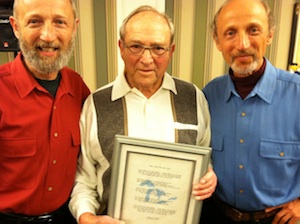
Carlos Fetterolf holding the lyrics to "These Lakes are Your Lakes"
Earlier this month we played in the Silver Maples Retirement Community's Kaleidoscope concert series in Chelsea. The day of our concert I got a phone call from Carlos Fetterolf, a resident at Silver Maples who I'd met last year at a concert my daughter Emily and I had played in Ann Arbor. Emily and I had ended that concert with This Land Is Your Land. After the show, Carlos had introduced himself, said he had some new verses for that song and that he'd send them to us. He soon did just that and now Carlos was calling to suggest that he join us at Silver Maples and sing those new verses with us. I agreed immediately and enthusiastically.
Carlos Fetterolf is now 85 years old. He says about himself, "As a kid I played with water and the things that lived in it. Then, armed with degrees from the University of Connecticut and Michigan State, I discovered that folks would pay me to do the same thing, using sophisticated words instead of "play." (For Carlos' full professional bio, see below.) In 1972, as a fishery and water quality scientist, he was appointed to the Great Lakes Science Advisory Board of the I.J.C. the Canada/US International Joint Commission which is charged by treaty to assure that actions within either country did not adversely affect the other's water quality or quantity agreements. After serving on that Board for eleven years his work was celebrated at a dinner in Indianapolis in 1983. He concluded his comments that night by urging people to "develop that Woody Guthrie feeling that not enough scientists, administrators, and legislators have. If you start thinking that These lakes are your lakes, these lakes are my lakes, these lakes were made for you and me' you'll start acting that way very quickly. This thinking translates easily into actions resulting in better management. Not only will the lakes be better off, we'll have a better feeling about ourselvesand so will future generations. Wouldn't we be proud to leave a legacy based on preventive programs rather than remedial ones."
Jack Vallentyne, a senior scientist with Fisheries and Oceans Canada was in the audience that night and, inspired by Carlos' remarks, penned some new verses to Woody Guthrie's song. These were the lyrics that Carlos proposed singing with us.
At Silver Maples that night, after a brief rehearsal with Carlos before the show, we invited him up on stage to sing the last song of our concert with us. Carlos opened his remarks by saying he'd never met a microphone he didn't like and, that at age 85 he was making his professional singing debut. (I interrupted him with an incredulous, "Professional? You didn't tell us we'd have to pay you!") Then, after Carlos told the audience the story of how the new verses to Woody Guthrie's This Land Is Your Land came to be written, we all three sang Woody's great chorus and then Carlos sang the new chorus and verses. His voice, an octave below ours, was in fine form and he sang flawlessly. The full house gave him a great whole-hearted ovation. Thank you, Carlos!
Here are the new verses that Jack Vallentyne, (Johnny Biosphere) wrote.
These lakes are your lakes. These lakes are my lakes.
From the Long Point marshes to the Nipigon highlands
From the Michigan sand dunes to the Thousand Islands
These lakes were made for you and me.
And there beside me in those clear mirrors
Came summer breezes and autumn colors
And winter snowstorms and springtime flowers
They said: These lakes were made for you and me.
Above Niagara I stood in wonder
At the rush of water and the roar of thunder
And way down under I heard her whisper
These lakes were made for you and me.
The sun was shining white clouds were drifting
And eagles soaring and rivers throbbing
And fish romancing the whole Earth dancing
These lakes were made for you and me.
Carlos Fetterolf's professional bio:
Carlos Fetterolf researched, managed, initiated, developed, resolved or administered fishery and water quality issues/programs for the Tennessee DNR, the Michigan Water Resources Commission, the National Academy of Sciences, the Michigan DNRE, the Canada-US Great Lakes Fishery Commission and the NOAA National Sea Grant College Program. Before he retired twenty years ago he was the CEO of the Canada/US Great Lakes Fishery Commission, an organization that is charged by treaty to revitalize the fishery which had been devastated by over fishing and the invading predaceous sea lamprey.
This Sunday, we'll play one of our favorites — the Thanksgiving Weekend Family Concert at the Ark Coffeehouse in Ann Arbor — an annual tradition for us for more than 25 years! If you are anywhere near here we'd love to see you at this show. And to whet your appetite for the show, here are the lyrics to a brand new song we've co-written (San wrote the lyrics, Laz wrote the music) which will receive its world premiere at the Ark:
I like chocolate, chocolate, chocolate, I like chocolate a lot
Fruits and lots of vegetables I know are good for me
So I’ve heard, and so I’ve learned, I’d never disagree
But the best research does not besmirch chocolate’s fame for sure
Scientists say, in their scientific way, that cocoa might even cure.
Chocolate’s antioxidants have healthy benefits
Eaten dark, it hits the mark, so everyone admits
It’s good for your heart and every other part, with its bioflavonoids,
I just say, please pass it my way, I don’t need no big woids.
Milky chocolate, though so fine, is not so good for you and me
Too many treats, too many sweets, and dentists we’ll need to see
So a word of caution, to balance devotion, to chocolate overdone
Too much of a good thing,
can and often does bring,
bellyaches not so much fun.
My mother's father, Gersten Samuel, was a handsome man, a slender, dashing figure with a large handlebar mustache, penetrating dark brown eyes, and a classic strong chin. My mother, Blanka, adored him. He smoked cigars, wore a silver watch fob, and dressed as a bit of a dandy. He was not, however, finicky. My mother often related how, whenever her mother tried to clear the plates from one course, before serving the next one, he would say, "I don't need a new plate, Karolina. Just put the next course right on this one — it's all going in the same stomach!"
He was an illegitimate child and bore the stigma all his life. Abandoned by his father, given away by his mother to an older, married, but childless sister, he was raised in a wealthy home and inherited a large house and enough money to live on comfortably. By day he was an accountant, but he spent his nights playing boogie-woogie piano in the smokey, racy nightclubs of Budapest. (One of the other stories my mother told about him was of the night, when she was two or three years old, when her father and mother were arguing, as they often did, about him going out again for the evening. She remembers standing up in her crib, saying to her mother, "He'll stay here for me." He didn't.)
He did, however, have extraordinary musical gifts. He was not only an excellent pianist; he had an uncanny ability to hear a piece of music once — sit down at the piano, and play it back from memory. If you hummed him a tune he could instantly play it, and then improvise variations on it.
He was much better at playing piano than he was at gambling, which is the other thing he did during those late nights in the clubs. He died of throat cancer when my mother was twelve, and the family was devastated to find out that he had squandered all his fortune. The house was all that was left, and my grandmother had to take in boarders to make ends meet.
He passed on his musical gifts to his only son, Nandor, who became a very fine classical pianist by his early teens, though he did not inherit the ability to play by ear. My mother, on the other hand, was not only unmusical — she was profoundly tone deaf. And yet, in the mysterious way that life and destiny unfold through time, my mother passed on her father's gift to me.
Though the image is vague, with hardly any details, I can still see the room where I first discovered this. I was about 10 years old. We were living in a tiny, ninety-family mosav (cooperative farm) called Ein Ayala, some forty miles south of Haifa, in Israel. We'd left Budapest two years before, in the wake of the Hungarian Revolution of 1956. I had been playing violin for three years by then — not very well, and not enjoying it particularly, but in those days, playing an instrument was considered a basic part of a well-rounded education. I took weekly lessons and was "encouraged" by my parents to practice every day.
It was late afternoon, I was alone in the house, and getting bored with practicing. As twilight approached, I started not being able to see the music on my music stand. Whatever I was working on had a D minor scale in it, starting on the open D string of the violin, and going up to the open A string. As I played these five notes in order — re, mi fa sol la — it struck me that this was the beginning of the melody of the Hatikvah, the Israeli National Anthem. (I later found out it was also a theme in The Moldau, a symphonic poem by the 19th Century Czech composer, Bedrich Smetana.) So when I got to the A string, I abandoned the notes on the sheet music in front of me, and continued playing the melody of the Hatikvah by ear — and was delighted and amazed to find that I could do it! Re mi fa sol la, la ti la ti re la, sol sol sol fa fa, mi re mi fa re. My fingers seemed to be magically, intimately and inevitably connected to my inner ear and to my memory of the melody, and I could no more play a wrong note on the violin, than I could sing a wrong one. I kept playing and finished the song, and tried a couple of others — with the same thrilling result.
I tried playing it in another key. Easy. I tried turning the melody from D minor to D major. Nothing to it. I tried making up simple melodies — hearing something inside, and simultaneously duplicating it on the violin — and this too was immediately available. It felt so simple and natural — I assumed everybody could do it, and I had just discovered that I too could do it. Like I'd lived in this house of music for three years, and just noticed that there was a door I'd never opened before — and I opened it, and found a fascinating, wondrous chamber on the other side.
That small room in the twilight, and me alone in the house, and the silence after I stopped playing, and the utter stillness, fullness, sense of satisfaction and happiness — I've never forgotten it. And yet, strangely, when my parents and brother came home, I didn't tell them about it. It had felt so natural that I was sure everyone could do it — and yet, at the same time, it felt like a secret I had stumbled on. And in order to protect its preciousness I needed to keep it a secret — not so much to hide it from others, but to keep it treasured inside.
I don't know if my mother had already told me about my grandfather Shamu, and his wonderful ability to play by ear, but in that moment of discovery, I'm sure I didn't think, "Oh, this is something I inherited from Grandpa Shamu." But now, looking back, I'm sure there is a connection — and I'm very grateful. Grateful that he developed this talent, and in some mysterious way, passed it on to me. And grateful to all those unknown ancestors, some of whom undoubtedly had this ability, each of whom developed it to some degree, and passed it on to the next ones in the line.
It's Go Blue time again. There's a new coach in town, he's doing well, and I have a memory of another Michigan coach.
I remember exactly where I was when President Kennedy was shot, when I heard about the Challenger explosion, and of course how I first heard about 9/11. To balance those, I remember, just as well, where I proposed, and my daughter's birth.
I also remember where I was when I heard that Bo Schembechler had died. Which is interesting, because I'm not that much of a football fan. I've lived in Ann Arbor since 1973 and have only been to two games. But I love the drama of all sports and so I check in on Michigan regularly on radio and TV and I'm always happy to hear when they win.
The closest I came to caring about one of Bo's victories was one Sunday in the Eighties, when my brother and I played a concert in Columbus the day after Bo's Wolverines upset the heavily favored Buckeyes. During that concert, unlike at most shows, we did not announce where we lived!
Here's what I remember about the day Bo died.
My wife and I were standing in our driveway that Friday afternoon in November of 2006, about to get in our car to go to an early movie, when one of our neighbors, a rabid Maize and Blue fan who got season tickets every year, walked up, face noticeably white, and asked us, "Did you hear that Bo died?" We hugged each other and I found my eyes welling up. After our neighbor left, my wife and I reminisced about meeting Bo once.
We were strolling on a quiet side street near campus one early August night in 1989 when we ran into Bo. Of course we recognized him. You couldn't live in Ann Arbor in the Seventies and Eighties and not be thoroughly familiar with that face and voice. He was alone and we stopped and made small talk for a couple of minutes. He didn't seem in a hurry, remarkable considering the Wolverines would open their season in a month. I don't recall what any of us said. I wish I did. Nothing noteworthy I'm sure, maybe something about the weather, or about some flowers in a nearby yard. I know we didn't talk football.
What struck me was the obvious interest he took in us. I don't think it was just because my wife is beautiful. She is, but he wasn't hitting on her. He also clearly wasn't sizing me up as a potential walkon prospect. I'm five foot nine and 135 pounds. I wouldn't have made the cut as a third string water boy on one of his teams. He just seemed to genuinely enjoy sharing a simple human contact with us. Our interaction was remarkably normal. He was completely without any of the mannerisms or shielding that might be expected in one so famous.
Throughout our conversation we didn't acknowledge who he was or address him by name. To have called him Bo, despite his ease and naturalness, would have been unthinkable. Mr. Schembechler didn't seem right either. But when we parted I said, "Good luck in the fall, Coach." And he said, "Thank you."
During the recent hot spell in Ann Arbor in July, we had a tree trimmed in our back yard. A huge black walnut had a dead limb hanging over our newly finished, and newly inhabited chicken coop. We called an arborist who's done tree work for us before. She and her assistant expertly cut off the branch in short order. Afterward, I asked her how she was doing in the unusual heat. She said they'd been working shorter hours to ensure her own and her workers' safety. I said I wasn't surprised; that Laz and I had played a number of outdoor concerts during the heat wave, that it had been hard to keep our instruments in tune, that we drank copiously to try to keep hydrated, and that we'd wrung a lot of sweat out of our t-shirts after each concert. "But," I added, "Our work was nowhere near as hard as what you do." She disagreed. This woman who routinely climbs tall trees, carrying a chainsaw that weighs considerably more than my guitar, said, "If I had to stand up in front of a bunch of people and sing, I'd be sweating bullets for a week before!"
Brought to mind a wonderful Sesame Street skit. A little girl skips up a few stairs and sits in a chair on a small stage. Next, the famed violinist, Itzhak Perlman, who had polio as a child, struggles up the same stairs with his crutches and leg braces, sits down next to the little girl and says, "You know, some things that are real easy for you are real hard for me." Then he picks up his violin and plays a few spectacular phrases. The little girl says, "Yeah, but some things are easy for you that are hard for me," and proceeds to play the beginning of Bach's Gavotte in G Minor—sounding like the beginning violinist that she is. Here's the link to this segment, which you might enjoy watching with your children or grandchildren.

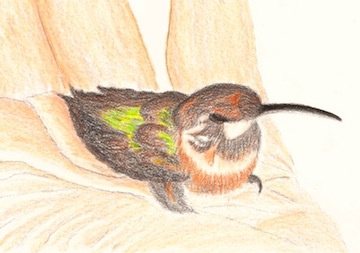 I want to tell you the story of an experience I had recently in Ecuador, and I invite you to experience it with me. You might want to take a deep breath to come fully present.