Blog
page 11
Perfect Pitch
Story (c) 2008 Sandor Slomovits
Music (c) Brian Brill and Sandor Slomovits
Here's a story about a little girl...
Though it could be about a little boy...
This story could even be about...you.
Once upon a time there was a girl named Rosalie.
Rosalie was a wonderful girl. She was always quiet, always sweet, always polite. Was she quiet? Yes. Was she sweet? Yes. Was she polite? Yes.
Always? No.
Sometimes, she was not completely quiet. Sometimes, she was not simply sweet. Sometimes, she was not perfectly polite.
But, most of the time she was quiet, sweet and polite.
Rosalie began learning to play the violin when she was seven years old.
Do you think the very first time Rosalie played her violin she sounded like that? Actually, she sounded more like this.
But you know, that very first time Rosalie played her violin, she heard something else besides those scratchy, out of tune notes. She heard something deep inside her. It wasn't a voice really, more like a feeling, but a feeling so strong and clear it seemed as if it was speaking to her. It said, "You can do this, Rosalie. You can do it, yes."
And from then on, Rosalie knew she could play the violin. Did that mean she never made mistakes? No. Did that mean she never got frustrated when she practiced? No. Do you think she ever got discouraged? Yes. But, she practiced every day, had wonderful teachers, her mom and dad always told her how much they enjoyed her playing, and so she learned quickly and very well.
Now, besides playing the violin, Rosalie also loved baseball. She began playing ball with her mom and dad when she was just a little girl.
Learning to play baseball was just like learning to play the violin. Do you think the first time Rosalie threw a ball it went exactly where she aimed it? No. Do you think she always caught the ball when her mom or dad tossed it to her? No. When they pitched to her, did she hit a home run every time? No.
But, as with the violin, she learned fast. She played catch with her mom and dad, they pitched to her, and she threw pop-ups to herself for hours in her back yard. Do you think she got better? Yes.
When Rosalie was seven years old, the same year she started to play the violin, she began playing softball on a team. The first few summers she played, her team's coach pitched to the girls. But the year Rosalie turned twelve, at the first spring practice, the coach announced, "This year, you girls will pitch to each other."
So, they began learning to pitch. Do you think Rosalie was a good pitcher right away? No. Her first pitches were...well, they were like her first "Twinkle Twinkle."
She threw high, she threw low, she threw wide, she threw close.
But, just like the first time she played her violin, she again had that feeling, again heard that voice. "You can do this, Rosalie. You can do it, yes.
So, after practice that day, Rosalie came home very excited and said to her mom and dad, "I'm going to be a pitcher." Her mom and dad immediately said, "No. No, you're not."
"Why not?" asked Rosalie.
Her mom and dad looked at each other. Her dad cleared his throat. Finally he said, "Girls who play violin don't pitch. Because when you pitch, you're the player closest to the batter and... your fingers could get hurt."
Rosalie immediately and correctly pointed out that the player closest to the batter was the catcher. Her mom said, "Yes, but catchers wear masks and padding. Besides, we don't want you to be a catcher either."
The truth was, Rosalie's mom and dad weren't really worried about her fingers. They worried that a batted ball could hurt her. They said. You can't do this, Rosalie. You can't do this, no. No!
"Please," she said, very quietly, sweetly, politely.
"No" said her mom and dad.
"It's not fair!" she said, a little less quietly, a little less sweetly, a little less politely.
"No," they said.
"Emily plays the violin," Rosalie shouted, "and her parents said they'd let her pitch!"
"No" said her parents.
Finally Rosalie said a few more things - not at all quietly, not at all sweetly, not at all politely.
She stamped her foot. She stamped her other foot. She marched out of the room. She stomped up the stairs. She slammed her door. Twice.
Rosalie's dad said, "It's OK. She'll forget about it by tomorrow." Rosalie's mom agreed, "Yeah, You're probably right. She'll forget about it by tomorrow."
You think Rosalie forgot?
For three days Rosalie cajoled, pleaded, begged constantly and her mom and dad continued to say no.
"I can do this - No you can't! No you can't! I can do this - NO! NO!"
"I can do this - No you can't! No you can't! I can do this - NO! NO!"
But, finally, Rosalie's mom remembered that when she was a little girl she too played ball - with boys no less. "Yeah, I got some bumps and bruises," she said. "I guess I survived."
Then Rosalie's dad remembered how once, when he was a boy playing in the outfield, he lost a fly ball in the sun, and the ball landed right on top of his head. "You can get hurt in the outfield, too," he said.
"Truth is, you can get hurt in life, but you can't let that stop you from doing the things you love." So, they told Rosalie, "You can try it Rosalie. You can try it, Yes, Yes!"
Rosalie was ecstatic. She hugged her mom and dad, told them they were the best parents ever, and ran right outside to practice. She pitched a softball against the side of their garage over and over and over.
Well, the first game rolled around. Rosalie was pretty nervous. But she wasn't nearly as nervous as her mom and dad. Her dad kept saying, "You'll be fine, you'll be fine, you'll be fine," the whole time she was warming up. Her mom kept saying, "Just keep breathing, just keep breathing."
Finally, it was game time. The ump brushed off home plate and shouted, "Play ball!"
Rosalie stood in the pitcher's circle as a girl from the other team stepped into the batter's box and swung her bat a few times. Rosalie went into her windup and threw her first pitch. It was a yard behind the batter and rolled all the way to the backstop.
Rosalie's mom drew in a sharp breath and held it.
Rosalie's second pitch sailed way over the batter's head and again rolled all the way to the backstop. Her dad groaned softly. The girls on the other team laughed and Rosalie's teammates shouted, "Settle down, Rosie! Settle down."
Rosalie's third pitch flew right at the batter and the girl barely jumped out of the way. There was a lot of laughing from the other team's bench and Rosalie's teammates were very quiet.
Rosalie took a deep breath, let it out slowly, and as she did, she heard the voice.
You can do this, Rosalie. You can do it. Yes. Yes!
Her next pitch was right over the heart of the plate. The ump's right hand went up and he growled, "Strike!"
The girls on the other team yelled to the batter, "She just got lucky. Don't swing. She'll walk you."
Rosalie's next pitch was another beauty. The ump said, "Strike two!"
"Yaay, Rosie," cheered Rosalie's teammates.
Rosalie's next pitch was a little outside, but the batter swung and missed. "Strike three. You're out."
Rosalie's mom let out the breath she'd been holding....phew... and started jumping up and down. Her dad pounded his fist into his glove and said, "I knew she could do it. I knew she could do it." Rosalie's teammates yelled, "Way to go, Rosie! Way to go."
Rosalie's face wore an expression just like the first time she drew a pretty sound from her violin.
Did Rosalie strike out every batter she faced that day? No. Did she only throw perfect pitches? No. Did her team win the game? YES, YES, YES, YES.
For the rest of that summer, Rosalie had some good innings and some bad. Her team won some games and lost some. But Rosalie continued to learn and to improve-in baseball, the violin, and in so many other things-and she never stopped listening to that voice inside her. "You can do this, Rosalie. You can do it. Yes. Yes. You can do this, Rosalie. You can do it. YES, YES, YES.
^ back to top
Excerpts from Ray Schairer's book, Barefoot Boy.
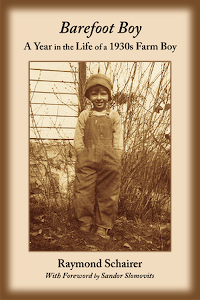 Raymond Schairer was born in 1922 and grew up on a farm just outside of Ann Arbor, Michigan, near the one founded by his great grandfather. Raymond’s ancestors were part of the first wave of German immigrants who came to the United States in the late 1820s, and were among the first Germans to settle in Michigan.
Raymond worked the eighty acre farm with his father, and later alone, until his retirement in 1990. In his childhood, and young adulthood, all their farming tools, plows, cultivators, manure spreaders, were pulled by horses. By the time Raymond retired, and for several decades before that, he was farming exclusively with tractors and combines.
Barefoot Boy is Raymond’s recollections of one year of his childhood, the year he was ten years old. Though the way of life he experienced then has long since disappeared, Raymond’s stories vividly evoke the richness of that time in the Midwestern United States.
Here are some excerpts from the book:
Foreword (by Sandor Slomovits)
I met Ray Schairer in 1977, when I was learning to play the “bones” from his friend, Percy Danforth. (More on that later.) Our paths crossed occasionally for the next twenty-five years. Then in the fall of 2002 I called him and asked if he would help me with a woodworking project. I wanted to build a music stand for my young daughter, Emily, who was learning to play the violin. I had neither the tools, nor the experience to make one by myself. Ray immediately agreed to help me and out of the process of working together on that project grew one of the warmest, most special friendships of my life. Ray was 80 years old at the time, I was 53 and our friendship had elements of both a father-son and a mentor-student relationship. I began visiting him weekly and we’d work in his shop, making wooden “bones” and other woodworking projects.
Soon after I started working with Ray, I learned that he was in a writing group at the Chelsea Retirement Community where he was living. I asked him to show me the stories he was writing. The book you hold in your hands now are those stories. They are Ray’s memories of one year of his childhood.
But first, a very brief biography of Ray and his wife Jane.
They met in the summer of 1946 on a blind date that lasted a week. Jane had been hearing about Ray for some time from her dad, Carl Schlosser, a retired farmer who worked at the Dexter Cooperative, a grain elevator and mill. “He would come home and tell me about this fellow that came in to have feed ground for his cattle, but I wasn’t really interested. I’d grown up on a farm. I knew what farming was like and what an unreliable kind of occupation it can be as far as steady income is concerned.”
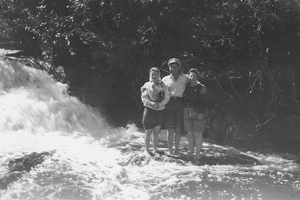
Jane, Harold and Helen Sias, on that first, fateful vacation up North.
Not that she was waiting for a husband to support her. She was teaching at a rural school near Chelsea, similar to the one she had attended as a child. In the evenings and summers she took classes at Michigan State Normal College, now Eastern Michigan University, to complete her college degree.
Ray and Jane finally met when Jane and her friend, Helen Sias, planned a vacation together to Michigan’s Upper Peninsula. Helen, a fellow teacher at the rural school had been, fifteen years earlier, Jane’s “beginner” or kindergarten teacher, and was now also studying at the Normal College.
At the same time that the two women were making their plans, Ray and Helen’s brother Harold, neighbors who sometimes helped each other with farming tasks, were planning a similar vacation.
Somehow, by now neither Ray nor Jane remember how, it was decided they would all go together.
A radical decision for the times, Jane recalls. “I was living on campus that summer and called home to explain to my mother that there had been a change in plans and the four of us would be going together. I still remember her saying, ‘Well, you ought to be old enough to know what you’re doing.’”
The week long vacation was uneventful and Ray and Jane didn’t see each other for nearly a year after, when Ray suddenly showed up at Jane’s parents’ house one spring evening. She opened the door and greeted him with, “Ray Schairer, what are you doing here?”
Jane’s dad was sitting nearby in a rocking chair that night and later told her many times, “I’d have never come back if I’d have been him.” But come back he did and they dated for the next three and a half years. Early on in their courtship Ray informed Jane, “I just want you to know that I really don’t ever plan on getting married, so if that is what you have in mind, we might as well call it quits right now.”
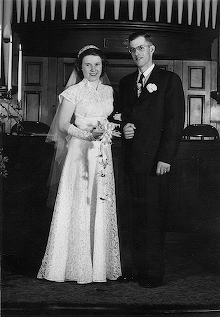
Jane and I on our wedding day.
Now, more than sixty years later, they both still laugh with delight at the memory. “Those were fighting words,” Jane says. “And I took the challenge!” They married in September of 1950 and built a home around the corner from the house Ray grew up in, where his parents were still living.
Ray, the third generation of Schairers to farm land near the corner of Jackson and Parker roads west of Ann Arbor, continued running the 120-acre family farm along with his dad. They planted grains, milked cattle, raised sheep and chickens – doing what used to be called general farming.
Jane meanwhile, was still teaching in the Chelsea village school. “That was a new idea, for farmers’ wives to continue working after they were married. I can remember how we practiced what we would say to our parents. We felt this would come as somewhat of a surprise to them. Our parents were extra-ordinary I think, as I look back on them and on our friends and some of the kinds of problems they had with their parents. Ours just kind of took in stride what we did. And if they had some doubts, they never let us know.”
After teaching for ten years and completing her college degree, a new opportunity came up for Jane. Some of her friends in the United Methodist Church of Chelsea were forming a cooperative nursery school, the precursor of today’s day care centers, and they asked Jane to help organize it. “The first year, we were on the third floor of the village government building in Chelsea. The fire station was in the same building. Every time the fire engines went out when school was in progress we would all run to the windows and watch them leave.”
In the mid Fifties many of the village schools were beginning to consolidate and to bus children from the rural areas. So the following year, the nursery school was able to buy—for one dollar—a small rural school from the Chelsea school system. During the ten years Jane taught there, the program went from two half days to two full days and an extra afternoon.
The actor Jeff Daniels is the most famous of her ex-students. ”But even today, I’ll read about people in the local newspaper and I’ll say ‘Oh, that’s one of my kids’.” Ray and Jane still run into Jeff Daniels occasionally and Ray laughs as he recalls telling Jeff one time, “The best thing I ever saw you do was when you played Tevye in Fiddler on the Roof when you were a senior in high school.”
Somewhere along the way Ray and Jane decided not to have children. “We were so busy and I think we thought we’d have them later, and then that didn’t quite work out. We considered adoption but Ray didn’t think that was the best route to go. Finally we just decided we wouldn’t do it.”
But they continued to be very involved with children and education. Jane, in addition to her work at the nursery school also did volunteer work with church youth groups.
“I had an office in the local Methodist Women’s Society of Christian Service and we filled out reports on what we were doing. And I could fill out those reports, make them quite lengthy, and make it look like we were doing a horrible amount of work in the Chelsea church. And we were doing some really good things with the youth at that point—and have to this day.” Eventually, in 1973 she became President of the United Methodist Women’s Organization, which coordinated the activities of local groups throughout the eastern half of Michigan’s Lower Peninsula and the entire Upper Peninsula. She also became the first lay woman elected to lead the Church’s General Conference delegation and the first to serve as Conference Secretary.
When her four-year term expired she accepted the position of Christian Education Director at the Chelsea Church. She held that position for more than seventeen years and worked with all age groups – infants to adults; coordinating classes, the library, a summer camp program and the work of more than a hundred volunteers every year. “The church has been good to me,” she says gratefully. “I have been able to travel and go to so many places I never would have gone to if it weren’t for my work.”
Although Ray’s primary occupation for most of his life has been farming, he has also taught children. For over fifty years he spent many Saturday afternoons in his workshop, teaching woodworking skills to boys and girls in the local 4-H program.
Like Jane, he keeps track of his former students. “They come up to me on the street sometimes and say, ‘You got me off to the right start. I just built my own house.’ Over the years I’ve had a number of these fellows tell me that what they’re doing now, is related to what they learned in my workshop. And they sent their kids back to me. I’ve taught two generations. ”
Ray’s workshop was a converted chicken coop he built using mostly recycled materials. When, in the mid Fifties, the Whitney Theater on North Main Street in Ann Arbor was being torn down, Ray and a friend of his hitched wagons to their tractors and drove to the site. “I had seen movies at that theater when it was up and running. We loaded up two by fours, plywood and all sorts of stuff and hauled it back to the farm. You can’t do that any more. You have to build using all new materials. The old stuff goes to the dump.” One of the interior walls of his workshop was paneled with a big plywood sign that was used to advertise “King Kong” when it had first shown at the theater.
It was Ray’s woodworking skills that got him involved in one of the longest friendships and business relationships of his life. In 1976 Percy Danforth, Ann Arbor’s internationally recognized “bones” virtuoso, came to Ray and asked him to make instruments for his students.
The “bones” are two pieces of wood, each about seven inches long, an inch wide and slightly curved, in the shape of rib bones. They are percussion instruments that sound similar to castanets and get their name from the curved animal bones that people played originally. They are considered among the oldest musical instruments played by human beings. There are drawings on the pyramids of Egypt depicting people playing the bones; they are mentioned in Shakespeare’s plays, and in the U.S. they were widely used in the vaudeville and minstrel shows popular in the late 19th century.
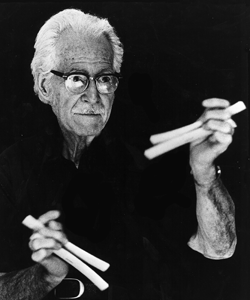
Percy Danforth playing the bones.
Percy learned to play the bones as a child in the early 1900s, and played them as a hobby all his life. In the 1970s he began playing the bones in a few public performances, and word of the unusual instruments spread. Soon Percy found himself teaching many students and needed instruments for them. He turned to Ray, who began crafting bones for him. Ray estimates that since 1976 he has made well over fifty thousand pairs of bones. He still uses as his template the original piece of wood that Percy brought him, to show how he wanted the bones shaped.
Making music has also been a lifelong passion for Ray. He has played piano since his teen years. “My grandmother bought the piano that I still play for my dad when he was six years old. We had a trio, my dad, sister and I. He played the violin and my sister played the saxophone. As long as I was accompanying them I could get away with it. But I didn’t want to be up there as a soloist. We played all sorts of places. In Chelsea the Kiwanis club used to put on shows, and between acts they’d get us to come up and play a little. Things like that.”
Being a farmer didn’t leave him very much time for playing, but since he’s been retired he’s been playing more. For a number of years, before he and Jane moved from their home, he played for people living in the Chelsea Retirement Center. “I played a little for them during the dinner hour once in a while. Just background music. I play some of the old time hymns and that’s what these elderly folks like. I tell them, ‘I’m not the best piano player’ and they say, ‘Oh but you play what we like to hear.’ And it’s great therapy for my fingers.” Today, he and Jane live in the CRC and Ray still plays regularly during church services and other occasions.
Ray and Jane have lived full, rich lives and have left their mark on their community. They have earned the respect and gratitude of three generations of people they have taught, guided and served.
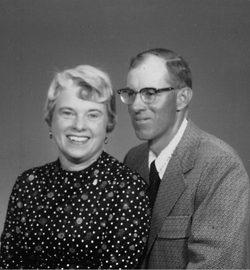
Introduction
I am 81 years old, at an age where I like to reminisce. I used to talk to the Lord and the birds and the animals all day when I farmed. Now I talk to people. Though I still keep quite busy, I have more time to think back and remember events and stories from my long life. Sometimes a conversation sparks a memory, sometimes something I read reminds me of my youth.
I grew up on a farm, near the one that was founded by my great grandfather, John Schairer, who was born in Durweiller, Germany in 1825 and immigrated to America as a young boy with his mother, Anna Maria and his stepfather John Jacob Jedele. (His father, Michael Schairer, died when John was a year old and his mother remarried.) The family was part of the first wave of German immigrants who came to the United States in the late 1820s, and were among the first Germans to settle near Ann Arbor, Michigan.
My great grandfather married Rosina Meyer in 1854. My grandfather, F. Jacob, who was born in 1861, was the fourth of their eleven children. He married my grandmother, Lizabeta Huss, in 1887. My father, Arthur, was born a year later, in 1888, and his brother Herbert, my uncle, was born in 1896.
I was born in 1922 and farmed with my father from the time I graduated high school in 1939 till I retired. Our eighty acre farm, located in Section 19 of Scio Township in Washtenaw County, on the corner of Parker and US-12 (now Jackson Road), is part of the land that my grandparents farmed, and which my father acquired when my grandfather retired. When I began farming with my dad we didn’t have a tractor. All our farming tools, plows, cultivators, manure spreaders, were pulled by horses. By the time I retired I was doing all my farming with tractors and combines.
It is now, as I begin to write these stories, a February evening in the year 2003. I am sitting in my easy chair, looking through a book of poems, “The Barefoot Boy,” by James Whitcomb Riley. I come across the words, “Barefoot boy with cheeks of tan.” And suddenly, I am transported back in time, more than seventy years. Then, I was a typical barefoot boy with cheeks of tan, and faded yellow curly hair. And of course, bib overalls! I’m glad I lived in the times I did.
Chapter One
It was 1932, the middle of the Great Depression and also the Dust Bowl days in the West that affected farmers even here in Michigan. We didn’t irrigate then. We just accepted the weather that nature gave us. The yields were much less in those years. The wheat grew hardly high enough to cut with a grain binder. The corn got no taller than five feet, and some years only knee high, and then it didn’t have any grain on it at all. The farmers would cut that and save the stalks for feed for the sheep and cattle in the winter. The drought hurt us, but not like it did farmers out west.
I was ten that year. It was early June and school was over for the summer. Country School ended right after Memorial Day in those days. It used to end even earlier, at the beginning of May, so kids could help with the planting, but that was before my time. I looked forward to the freedom before me—especially to going barefoot again. I never wore shoes during the summer then, except when we went to church. We just didn’t go much of any place else in those days. Neighboring farms were far away, half mile or mile was the closest. The men got together to help each other with farm chores, but we kids rarely saw our school friends during the summer.
On a farm there were chores even a ten year old boy was asked to do. One of my tasks was to get the cows from the pasture for the evening milking. The pasture field was as far away from the barn as could be, almost half a mile. Every late afternoon I would head across the barn yard to the lane that led to our wood lot, next to the pasture field.
I can see it now, as though it was yesterday.
****
I open the gate leading into the lane and start on my way. The path I follow has been used by the cows every day for a long time. The weather has been hot and dry, and the cows’ hooves have churned the good earth into deep layers of dust. The feeling, as my bare feet sink in and the dust oozes up between my toes, is almost ecstasy. It’s like walking on a soft, warm, sandy beach, or burying my hands in soft flour when I help make bread. On rainy days it was a different feeling, still wonderful, the mud squeezing up between my toes. But this was the drought years. We didn’t have a lot of rain those summers.
Sometimes, I step into fresh cow manure in my bare feet. It’s not a big deal, though. I just go to the well house, run water on my feet and dry them off in the grass. But there is no stepping into cow manure today. Just the fabulous feeling of my feet sinking into the dust.
A little further down the path my ecstasy is broken by the shrill cry of a killdeer protecting her nest. To the left of the lane is a cornfield planted a few weeks ago and the corn stalks are just forming their leaves. It’s a perfect place for the killdeer to make her nest on a little pile of pebbles, hidden under the sheltering leaves. I stop for a moment, assure her I will do her no harm, and continue on my way.
To the right of the lane is a hay field with clover and timothy waving in the summer breeze. The clover is beautiful with bright red blossoms, and the fragrance is unbelievable. I can almost smell the honey the bees will make from it. I keep walking and hear the sound of a bobolink. I find her perched at the edge of her nest, clinging to a tall weed amongst the clover. I start whistling, imitating her call. She’s evidently not impressed with my attempt to answer her and flies across the field. I continue on my way, soothing my feet in the wonderful dusty path.
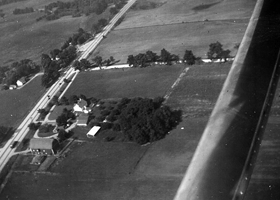
Aerial View of our Farm. I took this picture sometime in the 1940s from the rear cockpit of an open biplane.
There is a meadow lark flying up ahead of me. He has yellow, white and black markings. Continuing to whistle, I catch the sound of a big old robin. He is perched on top of a fence post near the end of the lane, and it seems as if he’s answering my call.
I have now reached the highest point along the way. From here I can see almost our whole farm. To the south is our big, hip roof barn, chicken coop, windmill and well house. Past them the trolley tracks run along Old U.S. 12, a two lane highway that was then the main road between Detroit and Chicago. Looking west I see my favorite big elm tree, our orchard and our new farm house. I can look across the corn field, and the hay field next to it, all the way to the big oak trees lining Parker Road. Their fresh new green leaves wave in the breeze. To the east is the timothy and clover field and to the north is the wood lot and past it, the pasture lot, where the cows are.
The lane leads to the wood lot and I skip along the path, stirring up the dust. I look up into the sky and spot two big turkey buzzards cavorting under the late afternoon clouds. I stick my arms straight out at my sides, and skip along, flapping my hands, I feel as if I am about to lift off to join them. Just then a crow lets out a raucous warning call from the top of a tree at the edge of the woods. That brings me back to reality and reminds me why I am here. I look over to the pasture field and see the cows grazing peacefully. I call to them, across the corn field, with my high pitched voice. “Com-boss, com-boss.” One of them hears me, raises her head, and looks my way. She answers back, the rest of the herd look at her, and all fifteen of them start for the wood lot on their journey to the barn.
While I wait at the end of the lane for the cows to come out of the woods I lean against the wire farm fence next to the hay field. I hear the dainty song of a bluebird. Her nest is in the old hollow post at the end of the lane. A woodpecker has made a hole in that post, big enough for the bluebird to make a home.
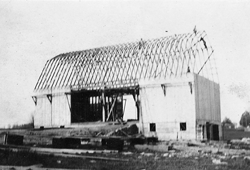
Our barn under construction,
circa 1917-18. Our first one was destroyed by a cyclone soon after
it was completed.
Here come the cows out of the woods, and just ahead of them a rabbit bounds into the lane. When he sees me he turns sharply and hops into the hay field. I am still leaning against the fence as the cows come by single file, kicking up the dry ground with their hooves. One young heifer pulls out of line to come over and nose at me, making sure I am who I am, and then continues on her way. I follow along, wriggling my toes in the deep, dusty, dry dirt all the way back.
The cows know where to go. They file into the barnyard and I drag the big, heavy, wooden gate across the lane behind them and secure it with a loop of rope hanging on the post. Then I head across the barn yard, past the barn, the chicken coop, well house and windmill and into our farmhouse. It’s time for supper.
Father and Mother, my sister Marjorie and little brother Lloyd and I gather around the table and Mother serves us big helpings of ham from the pig we butchered last fall, and home grown mashed potatoes. And, of course, milk. We all dig in. Except for Lloyd who, as usual, is playing with his food, making castles out of the mashed potatoes instead of eating. Mother tells him, “You gotta clean your plate, or you won’t get any desert.” That gets him going and Mother serves us some strawberries, fresh from the garden. Delicious.
Then, while Mother does the dishes and gets Lloyd ready for bed, Marjorie and I play hide and seek out in the yard and around the house while Father milks the cows.
Then it’s one final chore. I meet Father at the well house to help him cool the milk. We use water from our well to cool the milk from the cows before it’s sent to the dairy plant for bottling. Our thirty foot well, near the trolley tracks and the driveway leading to the highway, provides all the water for our homestead. Above the well stands a tall windmill and the wheel is connected to the well pump handle. If there is wind, the windmill pumps the water for us. When there is no wind though, we disconnect the pump handle from the windmill and pump by hand. That’s my job.
The water runs in a pipe from the well to the well house and then into a water tank where the milk cans, containing some ninety pounds of milk each, are placed for cooling. For the milk to cool properly, it has to be stirred frequently for about an hour to reach the required sixty degrees. It’s not a bad job if the wind blows and the windmill pumps the water. But, on days when there is no wind, I need to do more than just stir. I have to hurry to the base of the windmill, pump cool water into the tank, then run back and stir. Then it’s back to the windmill to pump some more water.
Tonight there is a breeze, so I don’t have to pump, just stir. The stirrer is a two foot long metal rod with a curved handle on top and a saucer shaped bottom piece, with holes in it. I lift it up and down in the milk can to stir the milk.
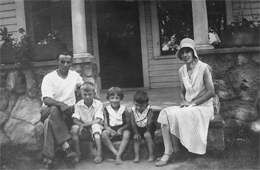
My father, Arthur, me, Marjorie, Lloyd, and my mother, Anna. July 1930.
When the milk is cool, my chores are done. I head back to the house for one of my favorite evening pastimes, listening to the radio. Marjorie and I pull our chairs up close to the big, tube set that sits on a small table in our downstairs hallway. My cousin Alfred (who we all call Boyce), Aunt Martha’s son, built that radio for our family this year. It’s the first radio we’ve ever had. It runs on a six volt car battery.
Some nights Father and Mother listen to Lowell Thomas reading the news, but almost every night at seven Marjorie and I tune in either Detroit’s WWJ, or Chicago’s WGN and follow the adventures of “Amos and Andy” and laugh. They’re funny.
After the fifteen minute show, Mother reminds us it’s time to wash up and head upstairs to bed. I watch the sunset from my west window and fall asleep to the sounds of the birds and the frogs down by the creek.
^ back to top
Trip to Budapest, Hungary, May 2008
Our parents and we emigrated from Hungary more than fifty years ago, in the wake of the 1956 Revolution. In May, we returned to Budapest for the first time since we left. We spent eight days there, revisiting places we remembered from our childhood, as well as sites that were significant and memorable to us and to our parents.
We went to the Halász-bástya, the Fishermen’s Bastion, which was one of our mother’s favorite places as a child and young woman growing up on the Buda side of the Danube. We recalled how she took us there a few days before we moved away from Hungary and said, “Remember this.” And we did.
We visited the famous Dohány Utca Templom, the largest synagogue in Europe, where our father occasionally led the services as Cantor in the 1950’s. It is, as everyone says, a stunning, ornate and beautiful building, inside and out. We remembered playing in the organ loft while our father sang at the bima, the pulpit, below. We went to Sabbath morning services at another, much smaller synagogue where our father also served as Cantor, and where the current Rabbi still remembered his name and said to us, “Coming back to the synagogue where your father was Cantor more than fifty years ago, that is something special.”
In two different cemeteries we found the graves of our maternal grandparents, both of whom had died long before we were born. We felt a mysterious, but very real connection to these people — just by seeing their graves — after having heard only stories about them from our mother.
We even found the apartment building in which our family had lived just before we left Hungary. When we walked into the courtyard, we vividly recalled how we had played on the balconies with our friends. Across the street is a small park with playground equipment. We remembered our mother taking us there a few days before moved away and telling us to go play in the mud! Her way of defying some absurd last minute regulation about not being allowed to take new clothes out of the country.
We also visited a small village, Kunhegyes, a three hour train ride east of Budapest, where our father lived and worked as Cantor and Rabbi before World War II. There we spent the day with a couple of women who have taken it upon themselves to preserve the memory of the Jewish community that existed in the village before the war, most of whom, including our father’s first wife and three young children, were killed in the Holocaust. The two women, both schoolteachers, have published a book about the Jews of Kunhegyes, in which they showed us references to our father. One particularly moving story was how some of the local residents still remember standing by the fence of the synagogue on Friday nights, listening to our father’s beautiful voice as he led the services.
It was a memorable, meaningful and deeply satisfying trip back to our birthplace and ancestral home.
And we didn’t forget about music. We visited the Kodály museum and learned, among many other things, that this very famous Hungarian composer, while receiving outstanding marks in all other subjects on his first grade report card, received merely “good” in singing.
We also heard a concert by a Hungarian band named Kaláka, (www.kalaka.hu) who play a large variety of traditional Hungarian instruments such as citera (zither) and furulya (flute) in addition to guitar, bass, and clarinet. We very much enjoyed their music and got to spend a little time with them. They invited us to come play at a folk festival they host every year in Budapest and we in turn are hoping to be able to host them on a tour of the US.
|

Laszlo at the Hálasz-bástya,
the Fishermen's Bastion.
|
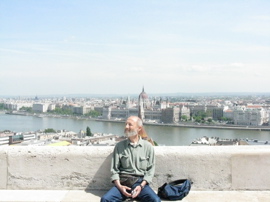
Sandor at the Hálasz-bástya, the
Dandube and Pest behind him.
|
|
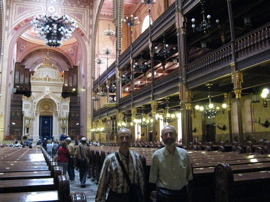
San and Laz in the magnificent Dohány Utca Templom, the largest synagogue in Europe.
|
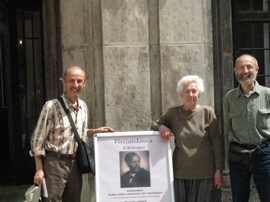
San and Laz with one of the curators
of the Kodály Museum.
|
^ back to top
School of Folk - The Siglins of the Ark
Sandor Slomovits
March 2008, Ann Arbor Observer
Photos: GREGORY FOX (top), PETER YATES
(view article as pdf)
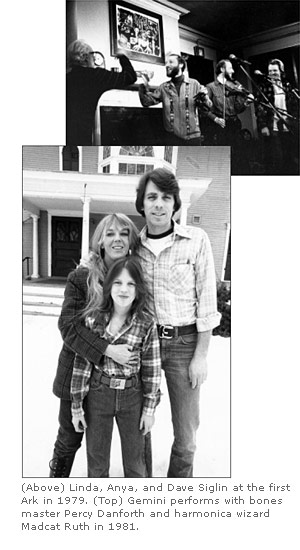
When my brother, Laz, and I moved here thirty-five years ago, we'd heard of only three things about Ann Arbor: the U-M (where my brother's wife-to-be was planning to start grad school), the radical Students for a Democratic Society, and the Ark. Even then it had a reputation as one of the best coffeehouses in the country.
I still vividly recall the first time we walked into the Ark that summer. It was a Wednesday night Hoot, when anyone who showed up could play (they call it "open stage" now). A few people were strumming guitars on the front porch of the massive gray Victorian, set far back from Hill Street. Inside, in the living room, a small crowd of people sat on cushions on the floor, listening to a performer standing in front of the big fireplace. Off the main hallway, the warm-up room was crammed with more folkies nervously picking guitars, frailing banjos, and sawing away on fiddles.
We signed in with Linda Siglin and told her we were new in town. She greeted us warmly, but she wisely scheduled us for late that evening, when, to put it charitably, the "less experienced" performers played. We were that. We'd played in public exactly once before.
But that was what the Ark was for, on Wednesday nights anyway — a chance to be bad, even very bad, and to learn and get better. It was, and continues to be, a School of Folk, with Linda and her husband, Dave, as principals. We came back week after week to play three songs and to hear other, more experienced musicians: Peter Madcat Ruth, Mustard's Retreat, Dick Siegel, and Cheryl Dawdy, Connie Huber, and Grace Morand, before they were the Chenille Sisters. We knew we'd arrived when one night, a year later, Linda invited us to finish the first set. It was the prize spot at the Hoot, because the audience was the largest then.
Linda emceed all the Hoots, but Dave was the official manager. Though he rarely spoke, he had a deep and encyclopedic knowledge of folk music and performers, and if you hung around late after shows and Hoots, you could learn much from listening to him. It soon became evident that he also listened carefully and paid attention to everyone. After a while he told us, "You've learned to use microphones, and you're also singing more quietly. The first few times you sang here, you'd blast me off the stairs." And then he scheduled us for our first professional show.
It's no exaggeration to say that if not for Dave and Linda, my brother and I might not have wound up playing music for a living — and certainly not performing the kind of music we play now, or the way we now play. Admittedly, if that were all Dave and Linda had accomplished in the past four decades, their achievement would not be that noteworthy, though unquestionably it has made all the difference in our lives. Truth is, though, I think they have had as profound an influence on the lives of countless other folk musicians and fans of folk music.
In those early years my brother and I came often to the Ark to hear the enormous variety Dave and Linda presented every week. We were particularly drawn to the music of the British Isles. We listened to John Roberts and Tony Barrand, Martin Carthy, Lou Killen, and the Boys of the Lough, and we started incorporating their songs and tunes into our sets. Then one night Dave said to us, "If you don't sing Hungarian and Israeli folk songs, who will?" He remembered that we had been born in Budapest and had lived in Israel for a few years, and he was gently giving us the same advice many young writers hear: write what you know. His words were transformative. They helped steer us to what was most genuine and authentic in our music.
I recall a number of other key conversations with Dave. Turned out he knew a lot more than just folk music. A few years ago, having sung only folk music before, I was starting to make tentative forays into singing jazz, and Dave booked my trio into the Ark. After the concert he suggested that besides listening to the great jazz vocalists, I should check out a relatively unknown jazz trombonist from the 1940s who he said had very vocal-like phrasing. I am certain Dave did not reserve his insightful comments and advice just for us, and that many other musicians benefited from talking with him.
Dave is retiring this month. The Ark will be in good hands. Anya, Dave and Linda's daughter, whom I remember when she was a little girl playing on the cushions on Hoot nights, will be taking over as program director along with the rest of the fine Ark staff.
The phrase "dedicating one's life" is bandied about frequently, especially in election season, but in the case of the Siglins, it fits. They have given so much to our community, and to the wider folk music community. Thank you, Dave and Linda.
^ back to top
Rumi: Poet of the Heart
©2007 Lazlo Slomovits
(This article was first published in the September 2007 issue of the Crazy Wisdom Community Journal. Thank you to Bill Zirinsky, owner and editor, and heartfelt thanks and credit to Coleman Barks, both for his magnificent translations, as well as for the stories of Rumi's life, on which much of this article is based.)
Come, come whoever you are -
wanderer, worshipper, lover
of leaving. It doesn't matter.
Ours is not a caravan of despair.
Come, even if you have broken your
vow a thousand times. Come,
come yet again, come.
This was the first poem I read by Jelaluddin Rumi, the 13th Century Sufi mystic, and I knew immediately that I had a friend. In just a few short lines he made it clear that he knew me (and most everybody else!) through and through - and loved us all unconditionally anyway. There is such hope and encouragement in those lines.
Reading more of his work I soon found out that, compassionate as he was, Rumi could be equally fierce with hypocritical or weak-spirited behavior.
Gamble everything for love
if you're a true human being.
If not, leave this gathering.
Half-heartedness does not
.....reach into majesty.
You set out to find God,
but then you keep stopping
.....for long periods
at mean-spirited roadhouses.
To this day, the more I enter Rumi's world, the more I discover the many-layered richness and variety of the perspectives he gives on life.
This September 30th marks Rumi's 800th birthday. Throughout these centuries, his work has inspired, encouraged, and delighted millions throughout the Middle East and beyond. Although Rumi began to be widely known in the English speaking world only about a hundred years ago, interest in his poetry has exploded to such an extent in recent years that he has become the best-selling poet in America. Popular icons such Deepak Chopra, Wayne Dyer, Demi Moore, and Julia Cameron quote him and express gratitude for the gifts he has brought into their lives - which they share with their large audiences. There is a moving story of Leonard Bernstein, the night before he died, asking for several Rumi poems to be read to him over and over.
But it's not just celebrities who have embraced Rumi. You find his poetry quoted in a huge variety of places - in books on creativity, psychology, and business, in self-help and spiritual books, on calendars, bookmarks, greeting cards. Calligraphers decorate his lines on hand made paper, illustrators paint his passionate images of love, dancers whirl to his mystical metaphors, and musicians improvise while poets recite his ecstatic verses. In recognition of his world-wide influence, UNESCO has designated 2007 as The Year of Rumi.
Rumi was born in 1207, near the city of Balkh, in what is now Afghanistan. During his childhood his family moved a number of times, fleeing before Genghis Khan's armies, finally settling in Konya, Turkey. One of the first legends about Rumi comes from this time of traveling. It is said that a great poet and teacher, Fariduddin Attar, recognized Rumi's greatness even as a boy. Seeing the young Rumi walking behind his father, (Bahauddin Walad, a highly respected theologian and mystic, and head of a medrese, a dervish learning community) Attar said, "Here comes a lake, followed by an ocean."
After his father's death, when Rumi was still in his early twenties, he became head of the medrese, quickly gaining a reputation as a great scholar, with many students. However, he himself continued to study with several renowned teachers, to deepen his understanding both on an intellectual and mystical level. He also married, fathered four children, and from the letters one of his sons preserved from this time, we know that he was actively involved in the practical affairs of the life of the community, as well as guiding it spiritually.
With all his knowledge and growing fame, it is said that Rumi knew his studying was incomplete and limited; he longed for deep transformation, not just more learning. Legend has it that, at the same time, a wild mystic, hermit and wanderer, Shams of Tabriz was praying to meet someone who yearned for God in the same passionate way he did, someone who could hold what he had to give. He asked inwardly again and again, "Who will be my friend?" Finally, a reply came in the form of a question. "What will you give?" Shams replied instantly, with no hesitation, "My life." "Your friend is Jelaluddin Rumi in Konya."
There are many stories about their initial meeting. In my favorite one, Rumi, then thirty seven years old, was sitting by a fountain in a square in Konya, reading to his students from rare books that included his father's writings on divine love. Suddenly, Shams pushed through the crowd and knocked all his books into the water. Rumi cried out, "Who are you and what are you doing?" Shams replied, "It's time for you to live what you've been reading about." Seeing Rumi looking despairingly at the precious books in the water, Shams reached into the pool and brought one up - dry. In some versions of the story Shams proceeded to restore all the miraculously dry books to Rumi - who now understood the dryness of mere intellectual knowledge. In others versions, when Shams offered to retrieve them, Rumi turned away from the books and said, "Leave them." Either way, the incident was symbolic of Rumi's initiation into a whole new level of experience, leaving behind his old way of perceiving the world.
Shams and Rumi secluded themselves for many days at a time, completely absorbed in sohbet, mystical conversation. Andrew Harvey, a contemporary Rumi scholar and translator says, "A massive transformation of Rumi's heart and whole being now began to take place in a transmission from Sham's heart to his. Shams knew he had very little time and that Rumi had to be utterly remade so that the revelations he was destined to transmit would be potent in him."
Part of the reason Shams knew he had little time was that he was twenty or more years older than Rumi. But another, more compelling reason, was the growing jealousy of Rumi's disciples, seeing the great influence Shams had on their teacher. Shams was forced to flee from Konya to Damascus. Rumi, overcome with grief at the separation, sent his son, Sultan Velad, to bring Shams back. But the jealousy and hatred of Rumi's students soon flared up again, and this time when Shams left - some say Rumi's disciples murdered him - he did not return.
This is when the Rumi whose poetry has come down to us through the centuries begins to emerge. According to legend, holding on to a pillar in his courtyard, Rumi began to turn around and around the pole, (this later became the basis of a core practice of the Mevlevi order of Sufi whirling dervishes) spontaneous poetry of intense longing pouring out of him. Students copied down his lyrics as he kept spinning in his grief. He traveled twice to Damascus, hoping against hope that he would find Shams. It was on his second trip, several years after Shams' disappearance, that a great revelation came to Rumi. He suddenly understood, experienced at the core of his being, that he and Shams were one - he carried Shams within himself. In a poem from that time Rumi expresses their total merging in an unbreakable bond of soul friendship. "Although I am far from you physically, without body or soul, we are one single lightÖI am him, he is me, O seeker."
This theme of union comes up again and again in Rumi's poetry in a wide variety of ways. It's in his gorgeous images of the lover and the Beloved,
Lovers don't finally meet somewhere
they're in each other all along.
in the powerful lines denouncing all divisions of religion that cause conflict between people,
Two hands, two feet, two eyes, good,
as it should be, but no separation
of the Friend and your loving.
Any dividing there
makes other untrue distinctions like "Jew,"
and "Christian," and "Muslim."
in the advice he gives us on how to live a fulfilling life,
Let the beauty we love be what we do.
in the sublime images of our intimate connection with nature,
What was said to the rose that made it open
was said to me here in my chest.
and most often, in the metaphors for the longing human beings feel to be one with God. Perhaps the most famous of these is the metaphor of the nay, the reed flute.
Listen to the story told by the reed,
of being separated.
"Since I was cut from the reedbed,
I have made this crying sound.
Anyone apart from someone he loves
understands what I say.
Anyone pulled from a source longs to go back."
The poetry kept flowing out of him for the rest of his life, for nearly 30 more years, along with a rich panoply of teaching stories and discourses. The sheer volume of his prolific writing is awe-inspiring - and with all the translations that have been done recently, it is estimated that still only about a third of his work has been rendered into English.
The person who is perhaps most responsible for Rumi's fame in America is his foremost translator, himself an eminent poet, Coleman Barks. He in turn credits Robert Bly, poet, translator and author of the classic book about men, "Iron John", with starting him on what has become his life work of translating Rumi. In 1976 Bly handed Barks a scholarly translation of Rumi and growled, "These poems need to be released from their cages." Bly himself had done a number of translations of Rumi, but since the late 1970's Barks has published book after book of versions of Rumi poems.
I've read Rumi's poetry off and on for many years, but since I heard, five months ago, about Rumi's 800th birthday coming up, I've felt drawn to immerse myself in his work, to read from his poetry almost every day, and to set some of his poems to music. Certain lines have started to come up spontaneously to guide and inspire me. For example, one poem begins,
The breeze at dawn has secrets to tell you. Don't go back to sleep!
Some mornings, when the pull to stay in bed is stronger than the knowledge that getting up to meditate and to work on a new song will be much more uplifting, those lines have actually bubbled up through the lethargy and have gotten me out of bed. Of course, like most of Rumi's poems, this one works on more than one level; going back to sleep can happen in a lot of ways, as we move through our daily lives - and Rumi wants us awake all the time, on all levels of our being.
I'm not the only one on whom Rumi has had this kind of effect. Coleman Barks says, "I find, as I explore the world of Rumi's work,
that I keep discovering those qualities with which I need attunement."
Hosain Mosavat, poet, photographer, instrument maker and former teacher, was born in Iran, but has lived in the Ann Arbor area for more than 50 years. He first heard Rumi the way many children still do in parts of the Middle East - his mother sang Rumi poems to him as lullabies. Later, Rumi's poems inspired him to start writing his own poetry - a practice he maintains to this day. When asked how Rumi's poetry has affected his life, he replies like a poet: "It has made me go through life with a sword in my heart, which severs love from that which is not love."
Gernot Windfuhr, Professor of Iranian Studies at the University of Michigan, first encountered Rumi as a student in Germany. He has seen the power of Rumi's influence not just in his own life, but in the lives of thousands of students who have been in his classes - many of which include a focus on Rumi - in the forty plus years he has been teaching. As a scholar, he is aware of subtleties of Rumi's artistry which, as he says, "are impossible to render in translation." And yet, he sees that what comes across to everyone is Rumi's "profound depth of longing, which is probably unsurpassed."
Domenic Tamborriello is a clinical social worker, who is also the primary organizer of RumiNations800, an Ann Arbor celebration of Rumi's 800th birthday, September 28-30. He said, "No one has braided the rope of the human with the rope of the divine like Rumi. Every poem is a love poem to God, or as Rumi would say, to the Beloved. He can find the presence of the Beloved in a drop of the ocean and help us become both that drop and the ocean itself."
As I talked with people about Rumi, it seemed that everyone - poet or not - gave amazingly poetic answers, Rumi's deep influence shining in their replies. Mahmoud Moallemian is a member of the Academic Computing and Network services at Michigan State University. Born in Iran, he has lived and worked in the US since 1982. "Rumi's poetry has taught me that love and tolerance are essential parts of living, especially in today's world." And then he begins to quote Rumi by heart,
From love thorns become flowers...
From love vinegar becomes wine...
From love fury turns to mercy....
And he continues reciting, each line beginning with, "From love..."
Everyone I asked about Rumi responded by talking about love in one form or another. Sepideh Vahidi, Iranian singer, painter and graduate student in Fine Arts at the University of Michigan, summed it up most simply, most eloquently. When I asked her, "What are the two or three most important teachings of Rumi - to you, personally?" She replied, "To be in love, to be in love and to be in love."
Rumi's love knew no boundaries.
The clear bead at the center changes everything.
There are no edges to my loving now.
I've heard it said there's a window that opens
from one mind to another,
but if there's no wall, there's no need
for fitting the window or the latch.
It was, and is, a love meant to dissolve what separates us from each other and from God - whatever our conception of God is. When Rumi died, on December 7th, 1273, his funeral procession included Christians, Jews, Moslems, and members of other faiths, all coming to honor the man who taught and so fully embodied universal love, a love that transcended religion, race, nationality and all the other artificial barriers humans put up between each other. This may be why, 800 years after his birth, he continues to inspire people all over the world - perhaps now more than ever - with a bright hope; that we can each live our lives in touch with our divine source, and from this core of our being, share with each other a profound vision of oneness.
^ back to top
West Side Story
©2007 San Slomovits
This article by San Slomovits appeared in the September issue of the Washtenaw Jewish News.
West Side Story is celebrating its Golden Anniversary this year. The classic musical premiered at the Winter Garden Theater on Broadway on September 26, 1957.
The idea for the musical predated its opening by ten years. In 1947, a friend of famed choreographer, Jerome Robbins, brought up the idea of updating Shakespeare's Romeo and Juliet. In 1949 Robbins and Leonard Bernstein began discussing that idea. The two had already worked together on a Broadway play, On the Town, an expansion of Robbins' 1944 ballet Fancy Free for which Bernstein wrote the score.
Originally, West Side Story, was to be about a Jewish girl and an Italian Catholic boy from Greenwich Village. In the play, at first tentatively titled, "East Side Story," the conflict was to be religious intolerance. That first draft fizzled and Robbins and Bernstein dropped the project for six years.
In 1955 they revisited the idea again, this time incorporating the new realities of the New York City of the time. In the intervening six years, there had been a large Puerto Rican immigration to the city, which created the usual and chronic American tensions between the established citizens and the new arrivals. Instead of Jewish/Catholic, the conflict in the play now became Anglo/Puerto Rican.
Shakespeare's Romeo and Juliet became Tony and Maria, the Montagues and Capulets were transformed into the Jets and the Sharks, medieval Verona, Italy was transmuted to the West Side of Manhattan, and the musical was titled West Side Story. (However, you could easily argue that although the story was no longer about religious intolerance, the lyrics of one of the best loved songs from the musical, "Somewhere," not only express Maria and Tony's hopes for finding a place free of prejudice for their love, but also perfectly describe the Jewish longing in the middle of the 20th century for a safe haven in a world long rife with anti-semitism.)
Robbins and Bernstein enlisted Stephen Sondheim, then still a young, not very well known composer and lyricist, (before the fame brought to him by A Funny Thing Happened on the Way to the Forum, Sweeney Todd, A Little Night Music, Company, Follies and other smash hits) to write the lyrics for Bernstein's music. Arthur Laurents was invited to write the book for the play. (Laurents was already well known for writing Home of the Brave and would go on to write Gypsy, also with Jerome Robbins.)
The musical created a sensation. The timeless story, modernized to reflect the harsh realities of 1950's urban America, the blending of superior and memorable music, dance and drama, and the collaborative effort of some of the most talented artists in a number of disciplines, made for an instant classic.
When the play opened in Washington DC a week before its Broadway premiere, Leonard Bernstein was invited to the Eisenhower White House for lunch. He later told his wife, actress Felicia Montealegre, "All were talking of nothing but 'West Side Story.' The Washington Post review called the musical, "a uniquely cohesive comment on life—the violence is senseless but Leonard Bernstein's score makes us feel what we do not understand." The New York Times hailed it as, "a profoundly moving show. Everything contributes to the total impression of wildness, ecstasy and anguish"
The show ran on Broadway for more than two years, 772 performances, and then began a yearlong national tour, before returning to Broadway for another 253 performances. The London production also ran for more than two years and won the London Drama Critics prize, even though it was competing with another no-slouch musical-set in London no less - My Fair Lady.
The film version of West Side Story, co-directed by Robert Wise and Jerome Robbins and starring Natalie Wood, took the musical to an enormous and worldwide audience. It's hard for us to picture today, when even the most successful feature films disappear from theaters after only a few weeks, only to soon reappear on DVDs, that the film version of West Side Story ran for an almost unprecedented 77 weeks-nearly a year and a half-after it opened at New York's Rivoli Theater in October of 1961. The overseas response was even more phenomenal. In Tokyo, it became the all-time top grosser at the Piccadilly Theater. In London it collected the greatest advance sales ever, while in Stockholm it was sold out months in advance. In Paris it ran for 218 weeks, more than four years!
In April of 1962 the film won ten Oscars, including Best Picture and Director, the most ever for a musical. Decades later, the film is still a treasured classic. It's been called the best film musical ever made. In 1998 the American Film Institute included it in its list of the "Top One Hundred Films of All Time."
West Side Story is just as relevant today as it must have seemed fifty years ago. Although the so-called "innocent" Fifties, and the sophisticated first decade of the 21st century are worlds apart in many ways, America today is still a magnet for immigrants from all over the world, and the centuries-old clashes between former immigrants-which almost all Americans are-and the most recent wave, remains a prominent part of our national dialog.
And, of course, it's not only an American tale. West Side Story continues to resonate with audiences, and even inspires today's filmmakers all over the world. Ann Hornaday wrote in The Washington Post recently, "And just this year, the Oscar for live action short film went to West Bank Story, which featured singing-and-dancing rumbles between two falafel stands, one Israeli and one Palestinian - complete with a star-crossed romance. Now that's entertainment to kvell about."
^ back to top
Eulogy For Our Mother
©2007 Sandor Slomovits and Lazlo Slomovits
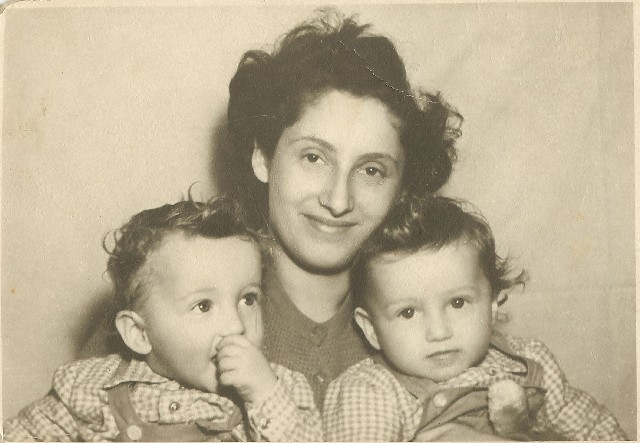
One of the defining moments in our Mom's life came in 1944, when she was 25 years old and living with her older sister in the Jewish Ghetto of Budapest. Their mother had just died and the Nazis were rounding up the Jews for deportation to concentration camps. As they were being herded along the streets of Budapest toward the outskirts of the city from where the railroad cars would leave, our mother became aware that they would pass by the apartment building where a Christian friend was hiding her fiancÈ's mother. Our mother was certain there would be room there for her and her sister too. She also noticed that they were being lightly guarded and urged her sister to drop out of the line and escape with her. But her sister was too frightened to try that, so our mother made the decision to stay with her, rather than abandon her.
And that's how, on December 4, 1944, her 26th birthday, she found herself crammed into a cattle car, on her way to Germany. In the ensuing months, whenever her sister would despair over the horrible conditions in the camps, our mother would say, "We'll show them. We're going to go home." On April 15, 1945 she and her sister were on a forced march near Dresden, their Nazi captors using them as human shields to protect them from bombardment by advancing Red Army and US troops. When the Nazis and their prisoners made camp that night our mother said, "That's it. I'm not going any further with them." Along with her sister and several other women she escaped and hid in the woods overnight. In the next few weeks they eventually made their way to a displaced persons camp and finally back to Hungary.
Fierce loyalty, bravery and resourcefulness, were qualities she would exhibit throughout the rest of her life. Here's just one example: Many years later, in September 2005, shortly after Hurricane Rita devastated the Gulf Coast, Hurricane Wilma wreaked major damage on parts of Florida; the area where our parents lived lost power for nine days. Our Dad was 94 and in poor health, and our Mom, at 86, was in not much better shape. With the elevator not working, and their being unable to walk down the stairs from their second floor condo, they were trapped in their home and relied on the kindness of neighbors to get them ice and food. After a week without air-conditioning, with candles as their only light - the apartment dark even during the day, the storm shutters still in place to keep the sun from overheating their rooms - without a single hot meal, and the stress from the uncertainty of how much longer this would go on, our Dad started visibly declining. Mom swung into action.
She remembered that the Mayor of Hallandale, Ms. Joy Cooper, had put her home phone number in the local paper saying, "If anybody ever needs anything, call me." Big mistake! Our Mom called her up and said, "My husband is 94 years old, and he's not had a decent meal in more than a week. What can you do?" Less than an hour later, the Mayor was at their door with two hot meals. Our Mom said, "Thank you. That's very nice. But we're kosher, and this is not." The Mayor apologized, and promised to make new arrangements. Our Mom gave the meals to a neighbor, and a half hour later, two bearded Hasidim from the local Chabad House arrived with hot, kosher meals. Our Mom called up the Mayor and said, "Thank you. That's very nice. But it's not enough. I can see that there are other buildings nearby that have electricity, and the service trucks keep going by our street. How come others in the area have electricity and we don't?" A half hour later the lights came on - she was the heroine of the building, and all the residents cheered her.
She was beautiful. In photos from her early twenties, before the war, she looked like a movie star. In later pictures, after giving birth to us at age 30, she looked radiant. Friday nights, after lighting the Shabbat candles, she'd put on a special flower-patterned robe, in which to greet our Dad when he came home from the Synagogue. When he placed his hands on our heads and recited the traditional blessing with which fathers bless their sons at the start of every Shabbat, our mother would stand behind us facing him. Among our sweetest memories of childhood is looking up at those times and seeing the tenderness in his eyes, directed at her. It was only years later, when we fell in love, that we started to understand how much joy she had brought into his life.
In an era (the late 1940's and 1950's) when most women had few choices for fulfillment aside from marriage and children, our mother embraced this destiny completely. Being a devoted wife and mother never seemed too constrained a life for her. From the vantage point of the liberated 60's it sometimes seemed like it could not possibly be enough, but for her it was a complete path to a meaningful life.
She was blessed with remarkable good health for much of her long life. The single day of work she missed was the day she fell on an icy sidewalk, hit her head and suffered a concussion. The next day she was back at her job in the garment factory where she worked full time, in addition to her homemaker role, after we moved to the United States in 1960. If there were other times she was ill-and she must have had her share of colds, headaches and stomach upsets-she never showed it or talked about it. And if she was sick with a minor ailment, it never stopped her from cooking for my father and us. Never. How do we know this? Because our Dad did not cook. Not at all. And neither he, nor we, ever missed a meal. Mom fixed them three times a day, every single day. Her motto was the same as that of the post office - the meals must go through - and no matter how she was feeling, they did!
(In addition to the three meals, there was also her famous afternoon snack which she gave us most days after school in a vain attempt at fattening us up. The "snack" consisted of the entire contents of a container of sour cream and one of cottage cheese, stirred together, with sugar added liberally, and served with a large bag of Wise potato chips on the side. Perhaps her one regret in life was that, despite this diet, she could not get us to put on much weight.)
Even after we left home for college she continued to bake big batches of cookies, pastries and sweets for us. Our Dad would package them up, and we would periodically receive huge boxes in the mail. Suddenly, everyone in our dorm was our friend! (She never stopped baking for us. Today, weeks after her death, we still have some of her cookies in our freezers.)
In 1957, when we were still young boys, our parents made the decision to leave their native Hungary in the wake of the 1956 Revolution. The week before we left, our Mom took us around to her favorite spots in her beloved Budapest, where she'd been born and raised. She said to us often that week, "Remember this, because we may not be back." And we have not been back, but we do remember - at least partly because of the love with which she showed us those places.
Despite not being raised in a religious home, she nevertheless had a deep faith in God. After our Dad passed away last year, someone insisted to her that she should go to the synagogue on the Jewish High Holidays, even though by then she could hardly walk, and could not sit for long without pain. The person told her, "You should go, because that's where God will be that day." She replied, "I think God is everywhere. I believe wherever I'm going to be that day, God will be there."
Though not at all musical-it was her bad luck to be tone deaf in a family of professional musicians-she loved music and had an instinctive knack for recognizing quality. It was she who came home from work humming the melodies of the hits of the day, she the one who insisted that we listen to the Beatles. (Our dad and we were musical snobs at the time, and only listened to Italian opera and chazzanut, Jewish liturgical music.) It was also she who used to drive us down to New York City for performances at the Metropolitan Opera House and Radio City Music Hall.
When people have asked us if we come from a musical family we've always credited both our parents equally. Our father passed on to us his voice and musicality, and from our mother we received our enthusiasm and joy.
She was always unfailingly supportive of our choice of career-and of our every other life choice for that matter. The phrase, "I just want you to be happy," never sounded like a stock platitude when she said it to us. Her fierce loyalty and unconditional love never dimmed or faded and was a constant source of nourishment and healing for us even to her last day-and beyond.
At her funeral, a slightly overcast afternoon in southern Florida, it began to rain unexpectedly right after we sprinkled the handful of Israeli soil on her coffin. And then a rainbow glistened low on the horizon for a few minutes before we began reciting the Kaddish, the mourner's prayer. We couldn't help laughing with delight at the perfection of her last farewell. We walked away from her grave filled with gratitude and even a tender joy.
^ back to top
Kaddish for a Cantor
©2006 Lazlo Slomovits
When I was in college and aspiring to be a poet, I went to every poetry reading in a series hosted by the University of Rochester. At one of these readings, the poet William Stafford was asked who his major literary influences were. I waited eagerly for his answer; maybe here would be a clue as to which combination of poets I should read so I could achieve the direct, lyrical, potent compression of language I so admired in Stafford's poetry. Would he cite as influences one of the English greats, Chaucer, Milton or Shakespeare? Would it be one of the American icons, Whitman, Dickinson, or Sandberg? Or perhaps it would be one of the poets he'd only read in translation, Rilke, Lorca or Neruda? Stafford's answer was bracing in its simplicity and honesty. "Yes, I could say all of those and others. But really, when I write, the voice that's before me is my mother's."
I didn't become a poet. I became a singer. And though I could truthfully say that I've been inspired by the singing of Caruso and Callas, Pete Seeger and the Weavers, The Beatles and Janis Joplin, to name just a few, the one whose voice is most before me when I sing is my father's.
My father, Cantor Herman Slomovits, Yechiel Tzvi Ben Yishayohu, passed away at age 97, on January 25, 2006. This is my Kaddish sung in his honor, my Yahrzeit candle lit in his memory.
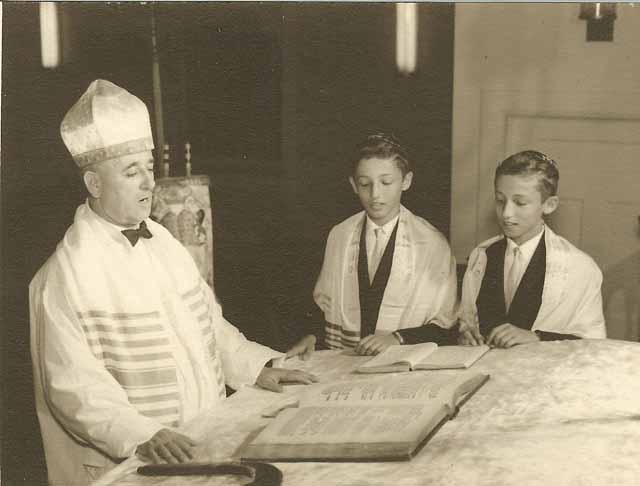
He was a truly wonderful singer, and my brother and I learned most of what we know about singing literally at his knee; we started singing with him as his two-boy choir when we were knee high to him. My father had a very simple, yet highly effective way of conducting with the forefinger of his right hand, the movement hardly visible to anyone in the congregation, but perfectly clear to San and me. The precise motion of that hand instilled a rock steady, yet flowing sense of rhythm in both of us. We learned about breathing, blending, harmonizing in the same way, almost without any formal lessons from him. He modeled it all thoroughly, patiently, and daily, and we absorbed it by singing with him.
His voice was an instrument of great beauty and power. But he was much more than just a Chazzan. He knew how to perform almost every function needed to run a Jewish community. The only two roles he did not fulfill, though he may well have been trained in them, were being a Mohel (the one who performs the bris, circumcision) and hand calligraphing a Torah.
Though he did not get his confirmation as a Rabbi (complying with his father's wishes, who thought the seminary he attended was not religious enough) he nevertheless completed his studies and served as Rabbi in Kunhegyes, Hungary, a small village about an hour from Budapest. Besides being the Rabbi for the Jewish families, he officiated as their Chazzan (Cantor), Baal Koreh (Torah reader), Shochet (Ritual Slaughterer), and Masgiach (the one who inspects and certifies meat as being Kosher). He performed all the weddings, officiated at all the funerals, and taught all the bar-mitzvah boys. He knew how to make and fix a tallis, t'fillin, and a mezuzah. He knew how to bake matzah for Pesach, how to build a sukkah for Sukkot, and how to find and collect the various willow branches needed for a lulav. He knew all the fine points of halacha (ritual), and in later years, when he served as Cantor under Rabbis less scholarly than he was, he'd often get into arguments with them - and he could always quote the resolving text by heart and then find it in scripture to prove himself right.
He also served as administrator of the synagogue in Kunhegyes, its chief fundraiser, and the main teacher of its Hebrew School. In addition, he became the liaison between the Jewish population and the general community, at a time when tact and good public relations skills were becoming more vital with the rise of anti-Semitism leading up to World War II.
And then, with the war, he lost almost everything - his wife and three children, his parents, three of his nine sisters, his only brother, numerous other relatives, and much of the community he'd served - of the 224 Jews who lived Kunhegyes before the war, only 95 returned. On the outside, almost everything was taken away from him. But the faith he had inside remained. And, of course, so did his knowledge and skills. My father moved up to Budapest and started over. He found administrative work in the Jewish Federation, started getting Cantorial jobs in some of the smaller synagogues, and eventually worked his way up to singing in the Doh·ny Utca Templom, the largest in Europe. While doing all of this he also found time to meet and marry my mother in 1947. My twin brother and I were born two years later.
My father had a prodigious memory that was completely intact even at the end of his life. But he also studied constantly. Every Sunday afternoon he'd sit down and start learning the next parsha, the portion of the Torah to be read the following Shabbat, and then he'd review it every day of the week. When my brother and I were growing up, people in his congregation would sometimes ask us, "Does your father know the whole Torah by heart? Because whatever we ask him, he can quote it chapter and verse in Hebrew, and then he can translate it, and give a commentary on it." Well, if he didn't know the entire Torah by heart, it would be hard to point to a passage he didn't know. In his later years when his eyesight was starting to go, he'd wear thick reading glasses, and hold a magnifying glass close to the scroll and he could still read the parsha faultlessly. We knew it was not just his eyesight he was relying on.
And whether he knew the Torah by heart or not, he certainly knew all the daily prayers inside and out, as well as the prayers associated with Shabbos and the Holidays. In his last year his eyesight got so bad that he could no longer read at all, even with the strongest magnifying glass. So he put down his siddur (prayer book) and sang the morning and evening prayers by heart. Just a few months ago, I sat next to him and followed along in my book, wondering if he really still knew it all by heart. He didn't miss a word.
Yet, of everything he knew how to do, with this tremendous range of skills and abilities that he had, what he did best of all was sing. He was the consummate Schliach Tzibur, messenger from the congregation to God. Whether singing a lilting, joyous Lecho Dodi to welcome the Sabbath Bride, or the centuries old pain-filled melody of Kol Nidre, he could move people to incredible heights and depths of feeling. Even when I was very young, 6 or 7 years old, I remember crying at his singing of some portions of the liturgy. I didn't know then why I was crying. I still don't know, except that his voice could reach inside you and touch the deepest feelings of devotion, gratitude and longing.
When we moved from Hungary to Israel and then to this country, he continued in many of the same roles - Cantor, Baal Koreh, Shochet, Masgiach, and Hebrew School teacher. And, of course, he continued to teach San and me - perhaps his most challenging task.
My father could be quite critical of various things my brother and I did or did not do, but I never remember him criticizing our singing. He might express disappointment in our grades when they were less than A's, our often unenthusiastic attendance at daily services, even about our other musical accomplishments, (mediocre piano and violin playing), but never about our singing. And this was not because we had beautiful voices as children. Yes, we could sing in tune and in rhythm, but our voices? I recently came across a tape of us singing at age 12 or so; the best I can say about the quality of our voices is that they would have been very useful in cleaning out earwax - at a distance!
Perhaps, my father's totally relaxed attitude about our singing came from his relationship to his own voice. Though there were times I saw outsized pride in his learning, which he could wield against those less educated or less intellectually capable, I never heard any of that in his voice when he sang. Like all of us, he could be egoic and opinionated about many things, but when he sang there was a simplicity, a directness, a power that transcended his personality. I think on some very basic level he understood and appreciated that his voice was a pure gift from God, and he offered it back in praise and worship as simply, naturally and purely as it was given to him.
In addition to possessing a beautiful voice, he was also blessed with the gift of composition, improvising intricate elaborations on the nusach (modes) of various holiday prayers, as well as creating many original melodies. He never really recorded either his voice or any of his compositions. My brother and I have just one reel-to-reel tape of three short pieces he recorded in his late forties in a studio in Haifa. He was hoping to use this demo tape to audition for jobs in synagogues in the United States. Our family was poor at the time, having recently left Hungary with two suitcases to our name, so my father didn't have much to invest in a recording. The studio and its engineers were second rate, the tape quality poor, and it had further deteriorated by the time we discovered it 20 years later. To make the whole thing worse, the piano accompaniment is embarrassing; the player obviously had never heard the music before, and with my father probably eyeing the studio clock, he probably had 5 minutes to rehearse it. Yet, with all of that, there comes through a sharp glint of the beauty of his voice, like an almost painfully bright ray of sunlight piercing through a crack in a wall.
Now that voice sings no more, but remains more than a memory to me. It is more than just genetically woven into my being. My father gave me many things, tangible and intangible, but that voice - in which mine is rooted - and its use in uplifting spirits, is my father's greatest gift to me. It's a gift he will keep giving me all my life.
^ back to top
Children's Letters of Sympathy
©2006 Sandor Slomovits
Laz and I were in the middle of a four-day residency at Purdy Elementary School in Fort Atkinson, Wisconsin when we got the news that our dad died. Everyone in the school community was extremely kind and generous, many going quite a bit out of their way to help us get down to Florida for the funeral.
When we eventually returned to our homes in Ann Arbor, we found a large package waiting for us, stuffed with letters and drawings from all the kids and staff at Purdy. (They also sent a beautiful bouquet of flowers to our mom.) The letters were very comforting; sweet, heartwarming, touching, full of profound empathy and understanding and Ö sometimes, very funny. In times of great sadness, perhaps tears of laughter heal as much as tears of pain.
Many of the children wrote expressions of sorrow and offered condolences.
I'm very sorry for your loss. I hope you feel better. I don't have anything else to say except I'm sad.
I would be really sad if my dad died.
Some of them were very observant and thoughtful.
When you were talking to us, I noticed you talked about your dad a lot.
My teacher told us your dad was ninety-seven. I hope he lived a nice long life, even though he was sick.
I'm sure your father thought you were awesome singers. I think you are.
Remember, even if your father is not there, you still have each other.
Some letters of sympathy were heartbreaking.
My dad died too. I feel sad for you.
I know how it feels because my grandpa died. It hurts very bad.
My grandpa died because he smoked and had cancer.
I'm sorry your dad died. I had a baby bunny and he died too.
Many offered encouragement.
A good suggestion for you is to look on the bright side. I hope you aren't too sad, because if you're sad, we'll be sad too.
It might seem like the end of the world, but luckily it's not. My grandpa passed away just last year and I'm still standing. Don't lose hope.
A number were very practical and looked ahead to our returning and finishing the residency-and even past that.
When you come back, I'll be ready to sing.
We're practicing.
Thank you for not quitting on our concert.
It just crushes my heart to hear about what happened to your father. I don't know how you will be able to come back to our school some day and just sing your heart out.
I hope you don't stop singing.
I hope this doesn't mess with your music career.
A few were a little off topic - but sweetly.
Both of you guys are kind and clean.
What was your dad's favorite band?
One child sent a rough drawing labeled, Captain Underpants.
Some offered wise and wonderful advice:
You should play a song at your dad's funeral.
Stay strong for your kids and your mom.
To make your mom happy, you could sing to her and give her a hug and a kiss.
A few showed children's lack of comprehension of the meaning of death; or perhaps showed a higher understanding than our adult one.
I hope your dad feels better.
And there were some that warmed our hearts-and exercised our belly-laugh muscles.
I am sorry your dad died. He must have been a nice guy to have around.
Too bad your dad died, and he was your dad and not someone else's.
It's nice you went home for your dad's funeral. I'm sure he would have done the same for you.
^ back to top
My Father's Heroes
©2006 Sandor Slomovits
My father always revered Jesse Owens and Joe Louis. Surprising heroes perhaps, for a man born and raised in far away Hungary. Not the heroes one might expect of a Jewish Cantor, whose work all his adult life had been the singing of liturgy in synagogues.
Yet, among the most vivid memories I have from my childhood in Hungary and Israel, through my teenage years in the United States, are the stories my father told of Jesse Owens and Joe Louis.
How one spring afternoon in 1935, coincidentally in Ann Arbor, Michigan, where I've lived since my early twenties, in the space of less than an hour, the magnificent Jesse Owens tied one world record and set five new ones. How one of those records, the long jump, lasted for more than twenty-five years; longer than any other record in modern track and field history. In his, and our, favorite story, my father told how Jesse Owens won four gold medals in the 1936 Berlin Olympics. How Owens' triumphs humiliated Hitler, who had predicted victory for, and had cheered on the German sprinters and jumpers. How Hitler hastily left the Olympic stadium after Owens' victory in the long jump, rather than stay to congratulate Owens. My father would explain, "Hitler didn't want to be seen in a photo with a Negro. He wouldn't shake Jesse Owens' hand."
My father also delighted in acting out the boxing dramas of Joe Louis. Many times, in our living room, back yard, or even occasionally before services in shul, he'd ball up his fists, get into a prize fighter's crouch and show us how the Brown Bomber landed the savage right to Max Schmeling's kidney that fractured two vertebrae in the unlucky challenger's back.
"Two minutes! Just two minutes and four seconds is all it took!" he would exclaim. "They say that a Texas millionaire was at ringside that night, wearing one of those big cowboy hats. When somebody accidentally knocked his hat off soon after the beginning of the fight, he bent down to get it. By the time he looked up, the fight was over." Saying this, my father would laugh till tears came to his eyes. Then he'd add dramatically, "Can you believe it? Hitler had even sent Schmeling a telegram before the fight. 'Congratulations to the new heavyweight champion of the world.'" Again he'd laugh. Again tears would fill his eyes.
My father was a gifted storyteller and the stories of great men were his favorite topic. He knew many stories. Some of them were of singers like him: of Moshe Koussevitzky, the legendary Cantor, Gigli, the great Italian operatic tenor. and Chaliapin, the famed Russian bass baritone. Others were about the teachings and sayings of the great Rabbis of history, and still others were of his childhood and adolescence in Hungary between the two World Wars.
Always, always though, he came back to the stories of Owens and Louis.
And, of his own father.
There are only two pictures left of my grandfather Shaya. In one he is a young man wearing his WW I Hungarian Army uniform. He is posing in profile, his rifle in his right hand, a long pickax in his left. On his back is a full knapsack, and binoculars hang from a strap around his neck. He was an advance scout. His assignment throughout the war was to climb mountains and lookout towers, occasionally behind enemy lines, and report on troop movements. His face, looking out of the old daguerreotype is calmly confident, almost defiant. A man aware of his powers.
When WW I ended, small bands of troops from the retreating Checkoslovakian Army, entered his city of Balassagyarmat and began looting homes. My grandfather stood by his front gate, rifle at the ready. "They are not coming in here," he said. And they didn't.
After the war, because of his Army service, Shaya was allowed a gun permit and carried a pistol in his travels as a peddler. When in the late Thirties the many restrictions against Jews began to be enforced, Shaya lost his permit and his gun. One day, traveling home from a successful selling trip he was attacked by two robbers. Wielding a loose plank from his cart, he knocked both men senseless.
When my father was about twelve years old, one Saturday morning he was walking home from synagogue services with a few of his friends. Grandfather Shaya and the other men were walking some distance behind them. A group of teenagers surrounded the boys, and began chanting, "dirty Jews, dirty Jews." When one of them yanked my father's payis, the customary long sideburns of religious Jews, and landed a blow to my father's head, Shaya came running and the young men fled. He caught two of them from behind and hit them so hard with a fist in each back that they fell face down on the ground.
In 1940, Shaya, despite being 53 years old, was ordered into the munkaszolg·lat, the work detail attached to the Hungarian Army into which many Jewish men were conscripted. Stationed far from home, he rarely saw his family. One week however, his unit camped only five kilometers from his home town of Balassagyarmat. That Friday, Shaya decided to walk home to spend the Sabbath with his family. He neglected to inform anyone that he was leaving. When he returned Sunday afternoon his commanding officer accused him of desertion. Shaya retorted, "I'm here. Besides," and at this point he stepped close to the officer and repeatedly tapped the man's chest with his index finger, "If you hadn't seen your wife and children in three months, and you were this close, what would you have done?" The matter was dropped.
Shaya was released from munkaszolg·lat when a lookout tower, like the ones he'd climbed more than twenty years before in WW I, now rotted from years of neglect, collapsed under him. He broke his right shoulder and several ribs and never quite recovered from his injuries.
When my brother and I were about sixteen years old, my mother told us one day that she was our father's second wife. That he'd lost his first wife and their three young children in the Holocaust.
This almost unbelievable news was barely comprehensible to me at first. And, it was somehow silently understood in our family that we would not talk about it with our father. After my mother's revelation that day, many years went by before I allowed myself to even think about these things, and years more before I braved talking about them with my father; years before I would understand the sadness I'd always sensed in my father even when I was still a little child, but whose cause I'd never before known; years before I knew why he kept to himself so much, why he rarely joined my mother and brother and me on family outings to parks or beaches, saying that he needed time to study for the next week's Torah reading. We all knew that was not true. He could almost recite the readings by heart after so many years of study and repetition. He didn't need to rehearse every Sunday afternoon, all afternoon.
The truth was, he wanted to be alone. It sometimes seemed to me that he wanted to be alone so much that he was not a part of our family. That day when my mother told us, twenty years after they were murdered, my father was still mourning his first family.
His frequent stories of Jesse Owens and Joe Louis gradually came to mean more to me. I began to see why the victories of Owens and Louis held such mythic power for him.
In June of 1938, when Joe Louis knocked out Max Schmeling, my father was living in Kunhegyes, a small town a hundred-twenty-five kilometers east of Budapest. He served as Rabbi, Cantor and school teacher for the Jewish families living in that community. Although he was happy in his life in Kunhegyes, he was well aware of the gathering horror of Hitler. After Krystalnacht in 1938 he had visible proof that Hitler's insane rantings could inspire very real violence. In 1942 that horror and violence pounded on his door. When war broke out, like his father Shaya, he was ordered into the munkaszolg·lat. He spent much of the rest of the war in work lagers in Poland. When he returned home to Kunhegyes in late 1944, my father discovered he had lost everything to the Nazis.
While he was away in the munkaszolg·lat, much of his family was taken to Auschwitz in cattle carts. There, besides numberless more distant relatives, he lost his father Shaya, his mother Rozsa, his only brother, three sisters, and, perhaps most excruciating of all, his wife, two sons and a daughter.
My father always believed that Shaya, had he not been recovering from the fall from the lookout tower, would have never been taken alive to Auschwitz. He was certain that Shaya would have taken to the grave with him a number of the Csendˆr, the hated Hungarian state police who rounded up Jews to transport to the Camps.
I used to have different fantasies, even more unrealistic. I dreamt that Shaya might have been able to save the whole family.
Jesse Owens and Joe Louis were exceptional men, worthy of my father's admiration. However, my father did not look up to them only for their athletic feats. He revered them because they did something he had not been able to do.
Jesse Owens and Joe Louis beat the Nazis.
^ back to top

